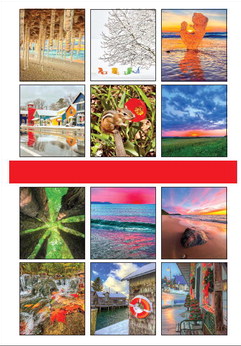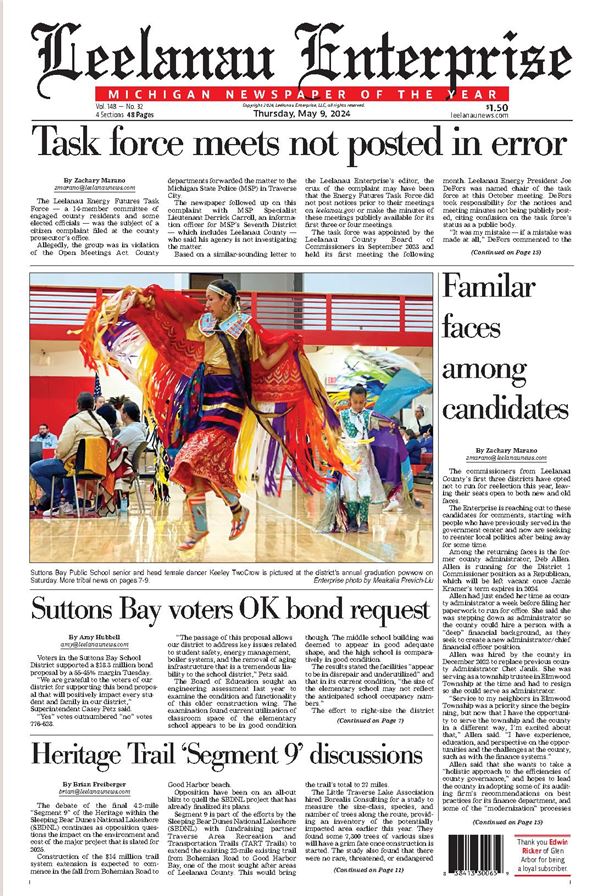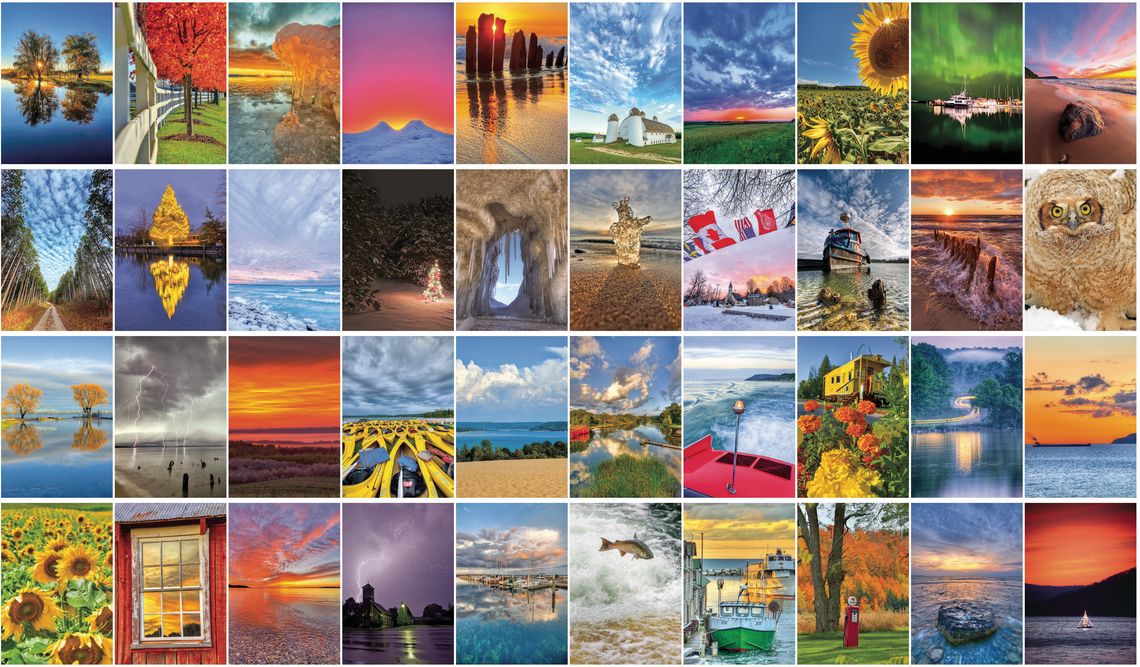
For the past 20 years, when readers reach the end of section one in the Leelanau Enterprise, they’re greeted by a familiar presence: a Ken Scott photograph.
Some weeks it is a dramatic shoreline, other weeks a quiet orchard, or fleeting moment of light most of us would have missed. After two decades, his work has become a part of the newspaper’s identity and a part of how many people see the county.
But for Scott, who lives just north of Suttons Bay, the weekly back page images have become a kind of gentle obligation — it’s something that gets him out the door.
“It’s an assignment to be out in nature, which is where I want to be anyway,” he said. “If I didn’t have the back page, I probably wouldn’t get out as much as I do.”
Scott admits that he’s a natural homebody, but the paper keeps him moving. Even on days when the light is flat or he’s sure he won’t find anything new, he’s still out there searching.
Scott’s relationship with photography dates back to his high school black and white photography class. From high school he served in the Air Force and then ended up as a caretaker at a small youth camp near Burt Lake. It was during those off season winters at Burt Lake that he started to truly develop his skills.
“I took notes on everything because I couldn’t afford to buy film and develop it at the same time,” he explained. “A lot of rolls of film just sat in the freezer until I had the cash to bail them out.”
That scarcity shaped him. A single 36 frame roll had to last a week or longer, and the habit of only taking one or two pictures per scene followed him well into the digital age. Even now, he says his first shot of a subject is usually his favorite.
It may come as a surprise that Scott doesn’t plan his pictures in advance. He doesn’t study weather apps to find the best timing or chase sunrises. Instead, he moves through his days and lets the pictures show up when they want to. He jokingly calls his outings “faux missions.” They aren’t about pho- tography, but they often put him in places where something catches his eye — a trail workday with the Leelanau Conservancy, early morning volunteer shifts at Samaritans’ Closet, even 4-H snowboarding lessons. He doesn’t volunteer to take pictures, but photography ends up happening along the way.
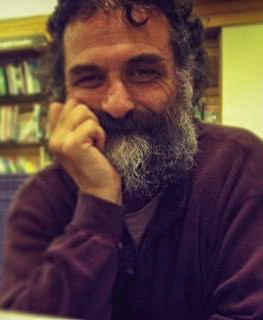
And when something makes him pause, he listens.
“Sometime I’ll be driving and something makes me do a double take and I have to stop and find out why. It’s the universe tapping me on the shoulder, saying ‘look at this’,” the photographer said.
Planned shots rarely workout for him because the imagined image never survives the conditions. It’s the unplanned ones, the ones that appear on the side of the road or at the end of a volunteer shift that have a way of sticking the landing.
Over time, Scott says that his work has gravitated to simplicity.
“The longer I do this, the more I try to simplify,” he explained. “An image is more powerful when there’s less to fight with.”
He especially loves the shoreline in the winter, when ice, storms, and waves have collaborated to reinvent the familiar spaces week after week. Summer, he says, is predictable. But winter is full of surprises.
The other parts of the year, spring and fall, can feel overwhelming to him. There’s almost too much color, too much happening, and never enough time to cover all of it.
“How do you take it all in?” he asked. “How can you be everywhere at once?”
Because Scott spends so much time alone outdoors, he doesn’t always realize how closely people follow his work. But every so often, the feedback reaches him.
“One guy told me he’d collected every back page and laminated them into a book,” he said with a laugh. Another reader once told him that she’d used his photos as wallpaper. Other readers have told him that his pictures allow them to feel a connection to the county when they can’t be here.
When asked how he got started doing the back pages for the Enterprise he simply said, “they asked me to.”
He sends a small batch of images each week and lets the editors choose which one will go best, and he laughed saying that the paper will never pick the one he would have picked.
Scott admits that after twenty years, there are still weeks when he cuts it close. The deadline looms, nothing seems to click, and he wonders if this is the week he will finally not have anything to send.
“But then I go out, and something presents itself. It always does.” Scott said.
For Scott, the back page isn’t just a spot in the paper, it’s a weekly ritual. It’s a practice that has shaped his life as much as his photography has shaped the way the readers see Leelanau.