The following is an excerpt from “A History of Leelanau Township” by the Leelanau Township Historical Writers Group.
In 1855 no roads had yet been opened. Some early settlers follow Indian trails on foot or followed the beaches to get to Traverse City.
In winter some traveled on the ice. In 1862 word came of the opening of a new state road from Newaygo to Northport. Hearing that the road had been cut out to Traverse City, 30 miles, Deacon Dame, 70 yearsold, started on foot to examine this route. It took him two days. He left word for a team to come after him. Next day, Captain Nelson, Mr. George Voice, and wife and the Deacon’s wife started out.
They arrived safely after 17 miles at a public house. It was 10 feet high but they had to enter on all fours. There was a place to build a fire with a hole in the roof for smoke to escape.
They ate boiled beef and cheese, then continued on the newly cleared road to Traverse City. Mrs. Voice and Mrs. Dame were the first women to travel this road.
One family, the Greenes, came to Northport in 1868 on a “side wheeler” with a covered wagon and horses aboard. They they drove through deep sand on a one-track road from Northport to Omena. In 1854, Mr. Califf arrived to see about getting help to open the road to Carp River (Leland). Rev. Dougherty and Rev. Smith started to Carp River to lay out a road. They overtook Deacon Dame and all stayed at Califf’s on the Carp River. On the way back they took supper at Onumunese (near Johnson Road) and went on home. They said they had laid the road through most beautiful country.
In 1870 a state road was laid out and more secondary roads opened. These were dirt and corduroy. In 1884 there was a stage service to Traverse City. There were two companies which alternated. John Sanburn’s and Wilber Steele’s. It was slower than going by boat. In 1890 Richard Thomas and Mr. Gill ran the stage. Following is a true copy of an original letter written by Richard (Dick) Thomas describing the journey.
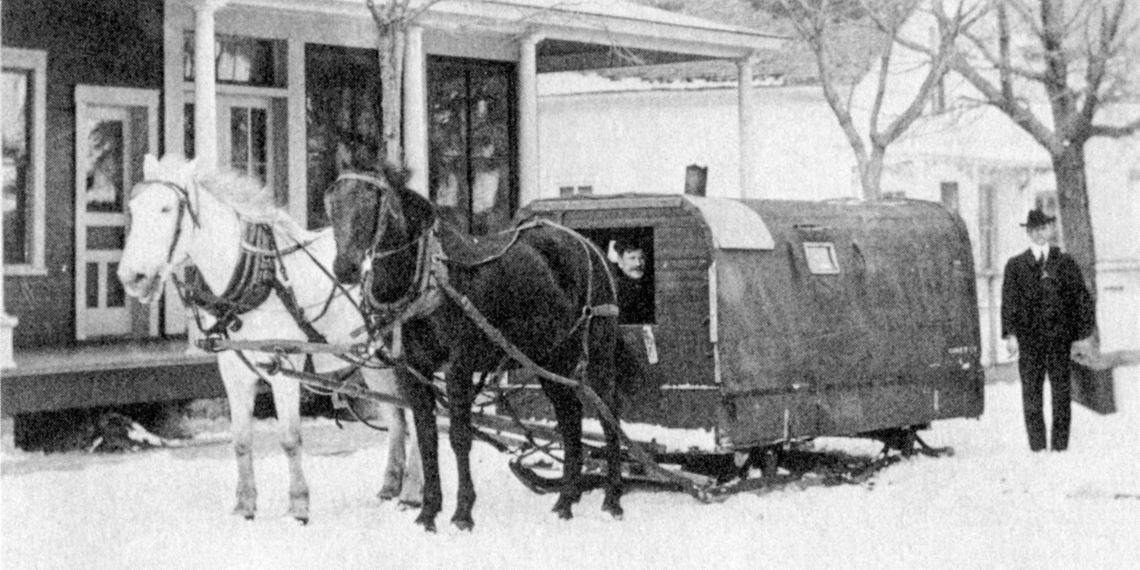
“It was in 1890 that I commended going south to Traverse one day and back the next with the stage. I had a partner then that went in the opposite direction on the same days. It was about 1900 that Gill and I started the route with one man going both ways in a day with three good teams and a covered sleigh with a stove. The rig was built large, strong and light. The house was 12 feet-by-6-feet covered with canvas. The runners were 7 feet so they carried up over the soft snow. I changed teams at Suttons Bay and Traverse City.
“There was but one day that I did not make the roundtrip. It snowed and ‘blowed’ the worst I ever saw it. The team had to wade above their needs. Two miles before I got to Suttons Bay one of the horses played out and that left but on to pull us through. I had one passenger and no freight except the mail and packages. We came to a drift in the snow 4 feet deep and could not get through so I turned into Rood’s house where I found a party of young people who came out and tramped down the snow so we could go on.
“Yes, I had a good many pleasant trips. One of them was when Levy Bahle brought his second wife to Suttons Bay. H e came to Traverse City and barely caught me as I was all loaded up. I told him the stage was full but he looked in and asked the other passengers to ‘set’ a little closer and make room for himself and his bride. The road was in excellent condition and so was the team. Mr. Bahle said we made the trip in a little less than two house (15 miles) the quickest ever made by him. There were 14 passengers, among them a teacher Miss Mork who got seasick and emptied her stomach in the bride’s lap. On this trip I also had a box of dry goods and four barrels of fish nets and leads that probably weighed over 1,000 pounds.
“My time was to leave Northport at 6 a.m., Omena at 7, Suttons Bay at 8:15 and arrive in Traverse at 11. Leave at 2 o’clock. By the time I got back to Suttons Bay it was dark. This made it harder to get on to Northport in the winter but I only got off the road once at Peshawbestown.
“There were no traffic law then but as a general thing the public helped me make good time. I had a bell on the neck yoke that could be heard 1/4 mile so people knew I was a-coming.
As there were no banks in this county, I was trusted at times with large sums of money. Once i left Traverse with $2,0000. I had two criminal-looking strangers as passengers which made me very uneasy.
“This is not complete without mentioning how the Government rewarded me for my service in started a round-trip route. They gave me a small sum of $2 per day instead of $4 which it was costing them in the 1890s, when two of us were driving. It did not get enough to feed my good horses as I paid $1 a day in Suttons Bay and in Traverse, $14 a week and fed one team at home when I only got $12 a week for pay.
I ran in debt $8 per week, to say nothing about hose shoeing and my board. May be that you will help me get a pension from the government for what I have done.”
To be continued next week.