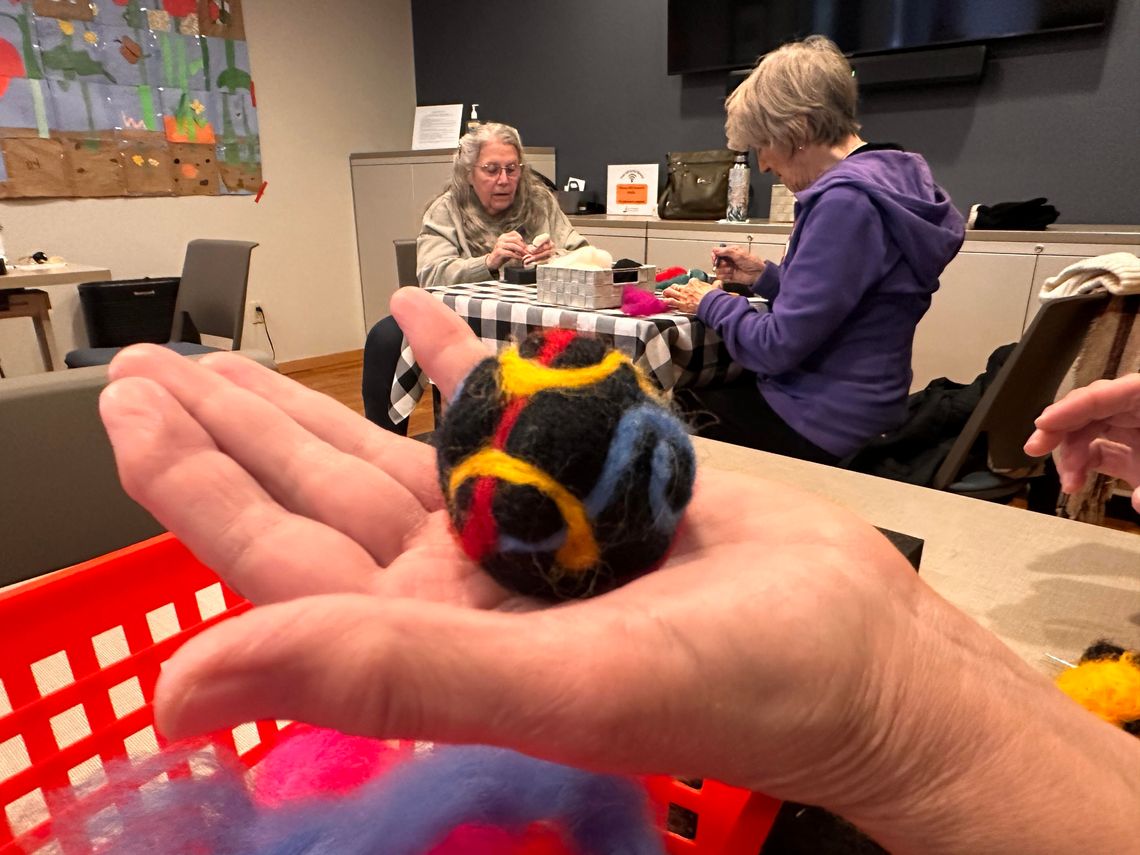
The community room in the lower level of Suttons Bay-Bingham District Library filled Saturday for the third of three felting events hosted by the library this year.
Of the dozen or so persons participating, just three in attendance had previous experience with the craft.
“There are two kinds of felting — needle and wet,” said Autumn Anderson, assistant librarian at the Suttons Bay-Bingham District Library. “We’ll be doing dry felting today.”
Dry felting, also known as needle felting, is a craft where barbed felting needles are used to repeatedly poke and tangle wool fibers (roving) together, bonding them into firm 2D designs or 3D sculptures, contrasting with wet felting which uses soap, water, and agitation to mat fibers.
Dry felting is nothing new.
According to feltcrafts.com, felt making is one of the oldest textile methods, originating thousands of years ago in Central Asia where nomadic cultures discovered that applying moisture and friction to animal fibers (like sheep’s wool) matted them into a strong fabric for yurts, clothing, and rugs, with ancient archaeological finds in Siberia dating back to 300-200 BCE; later, industrial machines in the 1800s advanced mass production, while the modern art of needle felting developed from repurposed industrial tools in the 1980s, becoming a popular craft for intricate sculptures.
Anderson distributed needed equipment, which included wool roving, felting needles, and a foam mat. Wool roving is a long, continuous rope of clean, carded wool fibers, slightly twisted to hold them together, making it fluffy, airy, and ready for spinning yarn or felting projects like 3D sculptures.
The act of felting is simply to stab the wool with the needle over and over again, causing the fibers to interlock and create a solid shape, a technique great for beginners wanting to make decorative art.
Newbies stabbed away while turning the wool, eventually formed a ball. Then, it was time for embellishments.
Sarah O’Brien from Traverse City was there with her 6-year-old daughter, Cece.
“It’s great to learn something new,” O’Brien said.
It was her first felting forray.
Across the room sat Nancy Hascall, of Centerville Township and the Kalamazoo area.
Her needlework was confident, swift and accurate, taking substantially less time than newcomers to the craft.
Her first piece, a round black ornament, was embellished with colorful wool swirls.
Hascall had time for a second piece, a more demanding project, a bird with wings.
While felters worked away, the room sometimes went quiet, interspersed with conversation and fellowship.
“They were able to try something new and have fun. It doesn’t have to look perfect,” Anderson said. “It’s more fun doing fun things with others.”
Saturday’s workshop was the last of three felting events held in 2025 year. All of these have been filled to capacity.
Additional workshop dates have not been set.
For more information go to sbbdl.org.