Cross country skiing for experts can be physically challenging, emotionally demanding and at times competitive.
Nordic skiing for beginners is more like working for your hot cocoa or rum coffee.
Lynn Bakker, a professional forester and farming spouse with Alan, has some simple advice for folks who have thought about cross country skiing but never strapped on bindings.
“Just go out and get in the woods.”
Lessons aren’t necessary, but they can speed up the learning curve.
Neither is expensive equipment, although eventually some people go all-out. That could cost $1,000, possibly more.
It’s perhaps better to start on the cheap. A quick glance through Facebook marketplace found dozens of cross country skis and ski outfits listed in the Traverse City area starting as low as $40. Or equip the family through a sales listing of 13 “vintage 80s and 90s’ cross country and downhill skis for $250. They’re advertised as wall decorations for a personal sports bar or business but heck, why not put them to work?
Renting skis for one day or a few is a possibility that often is accompanied with beginner’s tips and directions. Several businesses in Leelanau rent skis including Suttons Bay Bikes, where tour manager Jordan Peterson and outdoor sports veteran Keith Conway were busy Saturday helping clients customize cross country trips to fit their needs.
When asked, Peterson and Conway explained some nordic ski vernacular — skins or scales, wax or waxless, classic or skate. The ski types and techniques are worth knowing should a beginner stay in the sport and advance.
But to get started, it’s better to simply borrow, rent or buy a pair of waxless skis and take off for a taste of winter adventure, they suggest.
“The wax stuff, that’s a whole rabbit hole to go down,” offered Conway, whose grizzled soul patch and easy smile described him as a friendly dude, not a salesman.
If nothing else, though, understanding the language of nordic skiing offers lessons in physics that just might tempt a starter to move up a notch. For instance:
• The bend in cross country skis is called a kick zone or “camber,” which is basic to the seemingly unnatural nature of powering along on a slippery surface. The middle of one ski grips when weight is applied, while the other ski slides forward when pressure is removed because only the front and back are touching snow.
• The wax vs. waxless debate is all about the camber. The middle sections off waxless skis have rough surfaces, called fish scales —fingers slide when pushed one way; rub them the other way and they feel like, you guessed it, fish scales — or skins made synthetically or from mohair.
A sticky wax is rubbed onto the kick zones of wax cross country skis. For either style, glide wax when needed should be applied to fronts and backs.
Wax skis can get a bit compli- cated as different waxes are best under varying temperature conditions, in particular they create wet or dry snow.
• Classic skiing is the most popular style. Leelanau’s best known trails — the TART Trail from Greilickville to Suttons Bay, Sleeping Bear Heritage Trail from Empire to Co. Rd. 669, and trails in the Leelanau Conservancy’s Palmer Woods Nature Area — are groomed to provide side-by-side tracks. Several wineries in the county also cater to skiers.
Treat groomed trails reverently so the skier behind you can enjoy the same advantage.
That said, there’s nothing wrong with breaking your own trail on the way out, then backtracking to the starting point. Or make your own loop that with cooperation from snow and wind might be available the next day.
“Skating” looks as one would think with one ski angled outward for thrust while the other slides along.
Peterson, who grew up in the family restaurant business, drives across Traverse City to work because he enjoys helping people discover Leelanau County. He organizes and leads nordic tours in winter, and biking tours in summer.
Peterson considers the County one of the state’s premier cross country destinations.
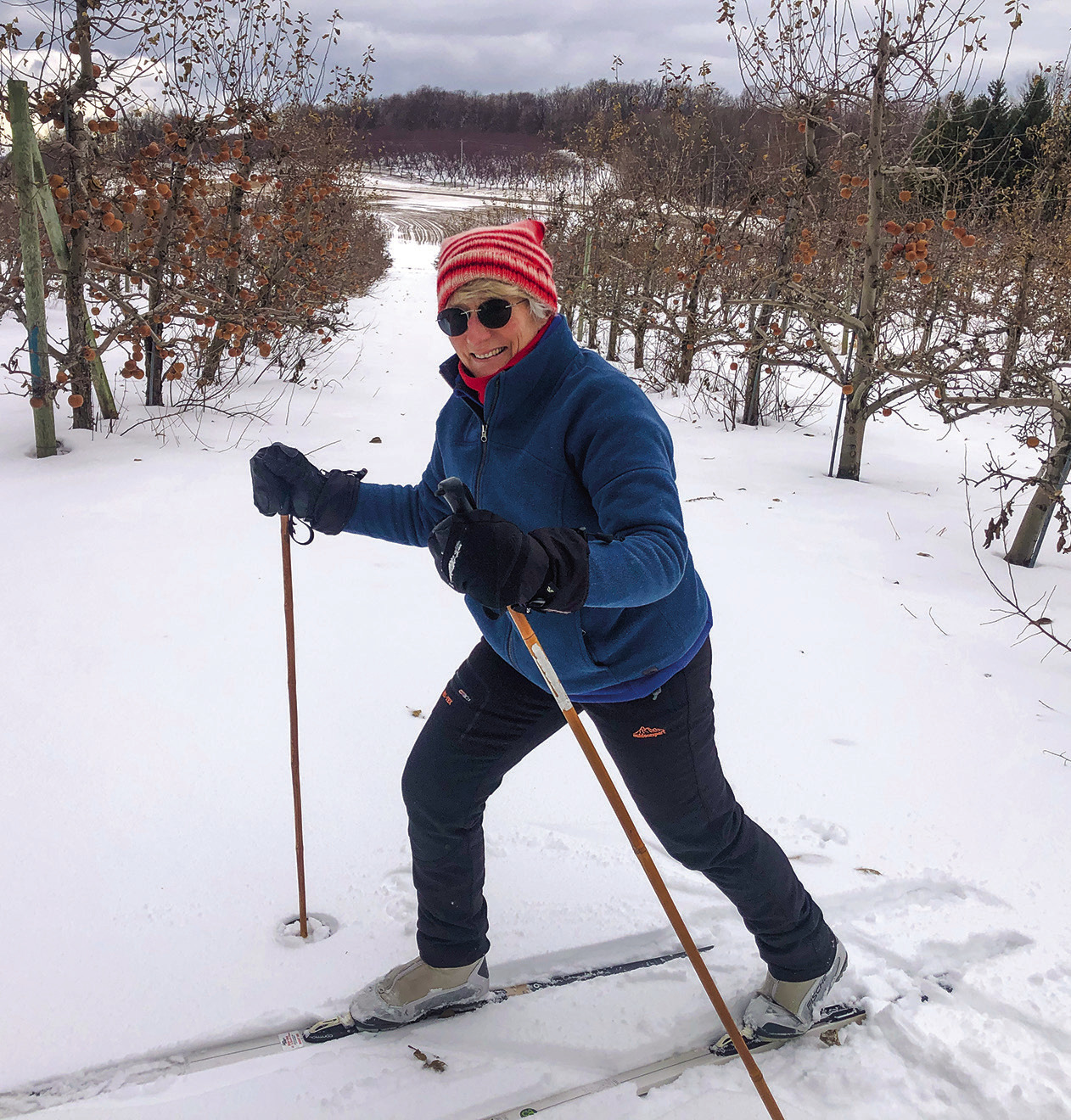
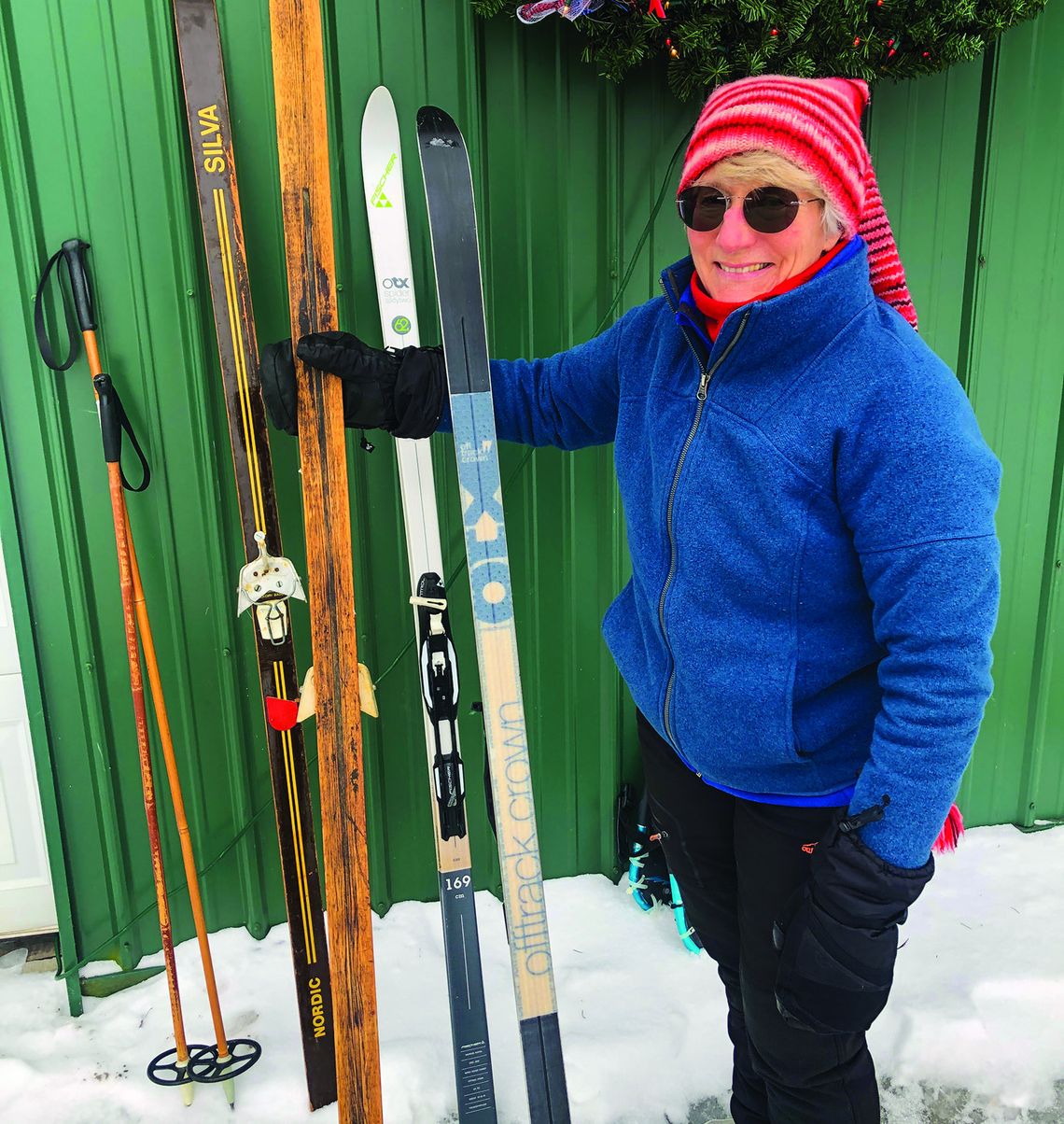
Lynn Bakker was swishing between a row of HoneyCrisp apple trees in northern Suttons Bay Township atop her 10-yearold waxless cross country skis. She also has 20-year old wax skis, but when she’s looking for a last-minute slide through woods and orchards at Bakkers Acres the waxless version suits her fine.
“I have waxable skis and there are certain conditions I really do like them. But I have to take the time to put that wax on. If I was in a race, I would. But usually I just want to put my skis on and go out,” she explained.
Bakker has been cross country skiing since she can recall, starting by slapping on downhill skis near her home in the Ramapo Mountains of New Jersey. Always an outdoor girl, she used a college degree to land a job as a forester for the Michigan Department of Natural Resources in Traverse City in the 1980s.
“Then I met Alan, and the rest is history,” Bakker said.
Her time working for the state provided lasting memories of helping to lay out the original VASA trail through public land in the Traverse City Unit of the Pere Marquette State Forest. The North American Vasa is considered one of the Midwest’s premier nordic ski events.
Cross country skiing is important for Bakker professionally, physically and emotionally. In winter, the forester often finds it easier to snowshoe or ski rather than walk while providing professional advice to landowners.
Skiing is also one of the best ways to stay in shape during winter months when the television tends to call for attention more than the outdoors.
And getting out in the woods helps put the world in perspective, she adds. Bakker loves skiing with her granddaughter Keilani Bakker.
“One time I asked her why she likes to go skiing, she said, ’So we can come back and have hot coco and cookies.”