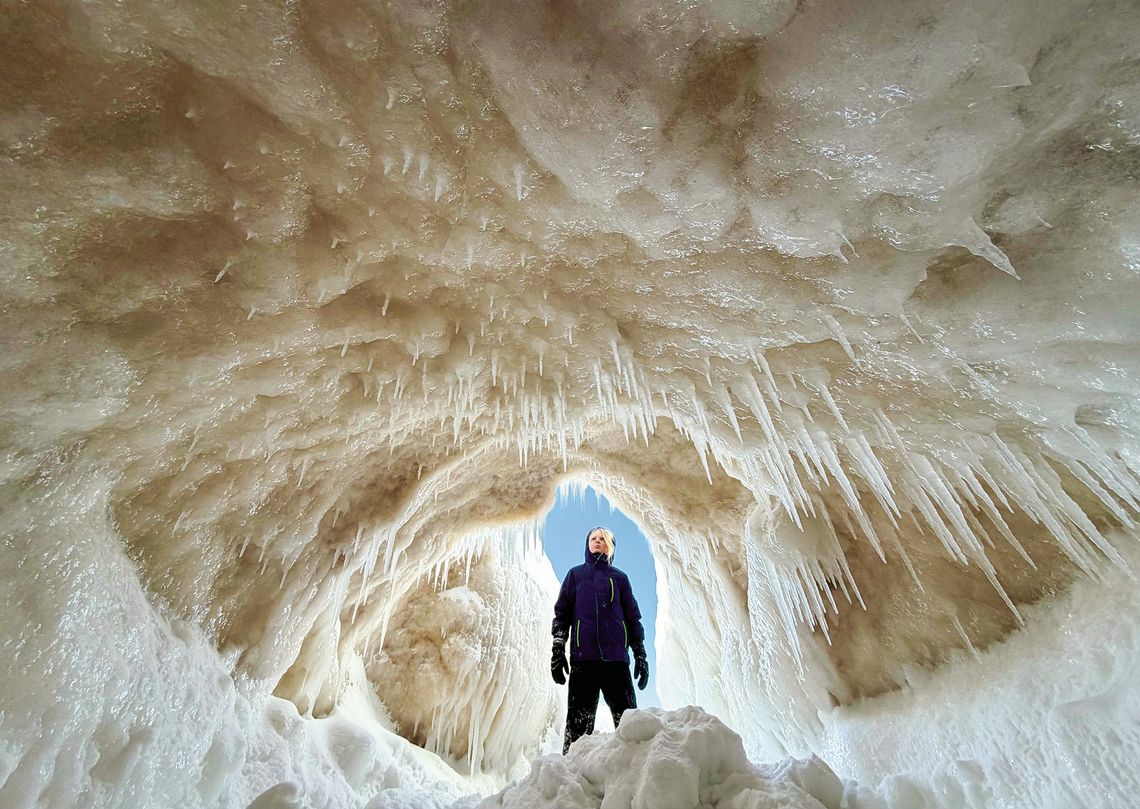
Ice caves are forming along the coast of Leelanau County, bringing both beauty and danger to this rare phenomenon.
James Schaberg was exploring Sleeping Bear Point in Glen Haven when he came across a series of ice caves and ice volcanoes.
“I’m always timid and cautious,” Schaberg said. “It’s rare to see them grow to this size.”
Schaberg says this is the largest set of ice caves or ice volcanoes he has seen since the winter of 2014-15, after growing up in the area.
As temperatures warmed up early this week, there may be some melt of the ice caves before colder temperatures return near the end of the week.
Ice volcanoes are cone-shaped mounds of ice, slush, and sediment that form along the shores of larger lakes when strong waves force water up through cracks in an ice shelf, freezing into structures that can grow over 20 feet tall.
An ice cave is a natural formation that happens when freezing temperatures and wave-sprayed lake water freeze into solid ice along the shore.
“I approach it with extreme caution and don’t go alone,” Schaberg said. “Go out with someone who has a device to call for help if you get into trouble. There is no safe way to get out, and one way to get in for some dangerous ice dams.”
Some of the most popular locations for ice caves include Empire, Glen Haven, Leland, and Northport. Suttons Bay may be frozen over, but there are no ice caves.
Stronger winds and waves can create larger caves with multiple openings, driven by wave thrusts.
“Stay well away from the actual edge of water and keep away by 100 feet ... I always investigate it from above before ever going below to see what ice formations have been created. The sunset is an amazing time to go with the warm light reflecting off the ice,” Schaberg said.
One person was hospitalized after falling into Lake Michigan near South Haven Sunday.
The person was taken to the hospital and suffered a leg injury about 100 yards offshore, representing the second such reported incident in the South Haven Area.
No accidents have been reported in northern Michigan.
As of the beginning of February, more than half of the Great Lakes are now covered in ice, with an additional frigid front arriving in northern Michigan today that will further extend ice cover, according to the U.S. National Ice Center.
The weather over the next week will range from the low single digits this weekend to the 20s, with a high of 32 degrees on Monday and Tuesday.
As of press time, only a third of Lake Michigan is frozen over.
Lake Superior is a third frozen over, as is Lake Ontario (37.23%). Lake Erie (95.33%), and Lake Huron (77.49%) reported higher.
Lake Michigan ice cover high was 93.2% in 2014. The last time Lake Erie was completely frozen over was in 1996.