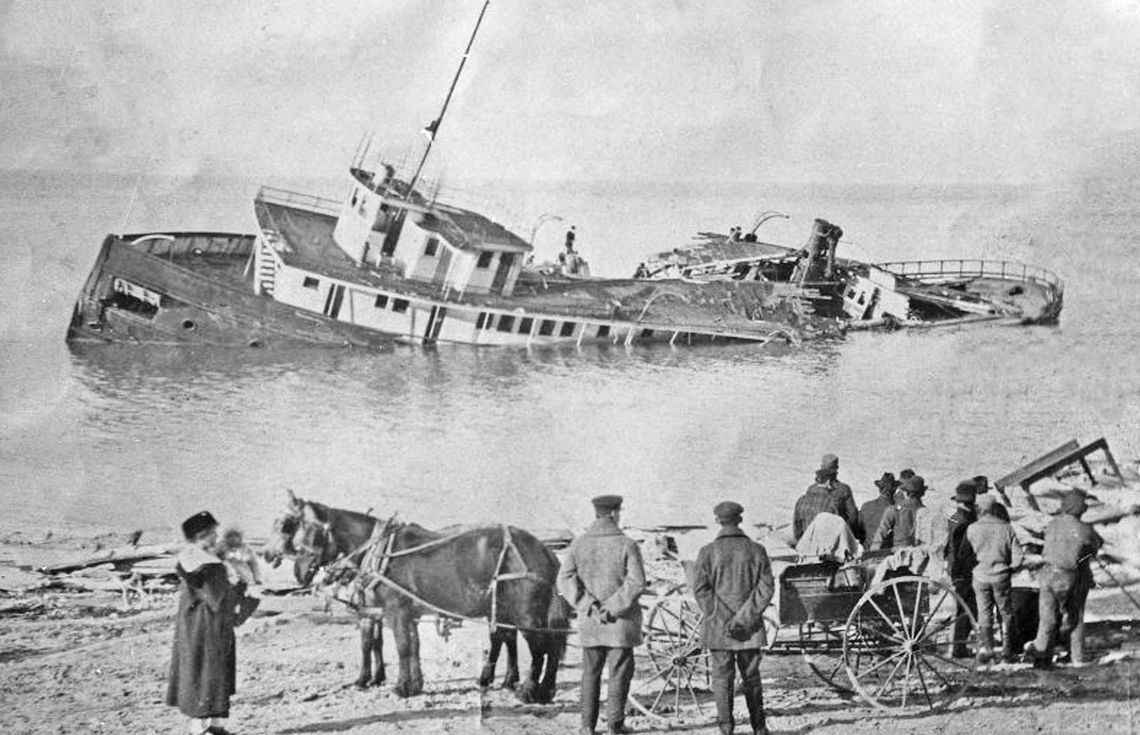
This continues a series adapted from the book, “A Port Oneida Collection,” Volume 1 of the twopart set, “Oral History, Photographs, and Maps from the Sleeping Bear Region,” produced by Tom Van Zoeren in partnership with Preserve Historic Sleeping Bear. Here we continue with the Baker Farm at the north end of Port Oneida Road, focusing on the wreck of the Rising Suns.
In the fall of 1917 the Rising Sun, a 133-foot wooden steamship owned and operated by the House of David religious sect of Benton Harbor, was moored by High Island in the Beaver Archipelago of Northern Lake Michigan. Members of the House of David believed that their leader, known as King Ben, was, as he claimed, God. They did not believe in cutting their hair or beards.
As the ship was being loaded with potatoes and lumber, a gale blew in with a heavy earlyseason snowstorm. Unable to maintain a mooring in that exposed place, Captain Charles Morrison headed his ship and 32 passengers south, seeking protection.
Approaching the Manitou Passage some 40 miles downlake, the captain seemed to be having a problem with the ship’s compass; however, he “had sailed the Passage hundreds of times,” and believed he “could put the ship safely through the Passage,” as he later explained. However, his ship struck the notorious shoal north of Pyramid Point.
As the ship began to break up in the pounding surf, the crew members and passengers had no choice but to climb into the lifeboats. Heading toward shore, one lifeboat full of children and other passengers capsized, but all managed to cling to the vessel and reach shore.
Some of the sailors were able to climb the high bluff, and eventually found the Baker Farmhouse. Lucille Barratt, the Bakers’ then-four-year-old daughter, told the tale: “So my dad woke up hearing a pounding and someone saying ‘For God’s sake, let us in! There has been a shipwreck!’ So he came down; and they were about frozen.
“. . . My Dad unloaded a wagon full of potatoes on the barn floor, hitched the team up, and drove down the beach, where they picked up survivors, all wet and cold. One woman was found unconscious. In the meantime my mother built up fires in the kitchen stoves to dry the men’s outer clothes. The two or three men that stayed all had heavy beards, and when they took off their caps they also had long hair—which frightened my mother!”
Fred Baker remembered the night this way: “I got up and went down and put a lot of hay in the wagon box. It was snowing and blowing and yet there was enough light that I could see any driftwood, so the horses wouldn’t get hurt. I went down and loaded the women and children in the wagon. I dumped one woman off here at our place and my wife took care of her. I had Doctor Fralick [of Maple City] come out, and he says her lungs were filled with sand.”
Eventually everyone on the beach was miraculously found and collected before succumbing to hypothermia; but a headcount revealed that someone was missing. A frantic search continued until morning when an elderly passenger was spotted waving a flag from the pilot house of the ship. Upon his rescue, all were saved. Many Port Oneida households took in and cared for survivors until they were able to travel.