The following news story and photos were taken from Kathleen Firestone’s book, “Suttons Bay, Peshawbestown and Bingham Shores of Grand Traverse Bay.”
Spring came a little early in 1902, and by the end of April, schooners would come into Suttons Bay to pick up last fall’s potatoes.
That summer, to make things a little easier for the townspeople, Wyman Strong Company built a walk from the dock to the main street in Suttons Bay. The “Grand Traverse Herald” reported “It is possible now to walk from one’s home on a rainy day to the boat on a firstclass sidewalk without loading each foot with a few pounds of old rubber. The Herald didn’t mention which dock.
Erastus R. Dailey had been manager of the successful Empire Lumber Company since 1899.
Dailey and his wife Marcella had formed a partnership in 1899, with five Suttons Bay neighbors — Charles and Mary Stanley, Joseph Steimel, William Wyman and John Borgusen. The new E.R. Dailey Company would still have its headquarters in Suttons Bay, even though the Daileys were listed as residents of Empire.
The stated purpose of the partnership was “Dealing with General Merchandise, Farm products, Manufacturing and dealing in Logs, Lumber, Ties, posts and all forest products.”
In 1902 the Greilicks sold their Suttons Bay mill to E.R. Dailey, who had bought the Johnson, Goodnow Dock in 1894. Daily converted the Greilick mill to a barrel stave and heading mill and hired Gerhard Nordhaus to operate the mill. But soon Nordhaus left, and Carron and Diepenbrock were hired. They redesigned it to be an excelsior mill. Excelsior was softwood shavings use for packing fragile things and for stuffing furniture. The excelsior mill operated where Carr & Fox had built the first sawmill in Suttons Bay.
The shoreline where Harry Sutton, and then Capt. Ferdinand, once had a dock had pass through ownership of Herbtrit, Carr and Fox, and the Greilick Bros., to become E.R. Dailey’s dock. The earlier L-shaped dock had become a wide, U-shape, and the Bahle dock was close by.
The Deusters were no longer hosting fairs and other events on their vacant property at the north end of town, In 1902, John Deuster II, sold Deuster Grove to Leelanau County, which in turn, sold it to the Village of Suttons Bay. John kept rights to the two-track road that crossed the fair property, so he could get to his adjoining agricultural property to the north. The new village property has been used as public parking, and for baseball games and other events.
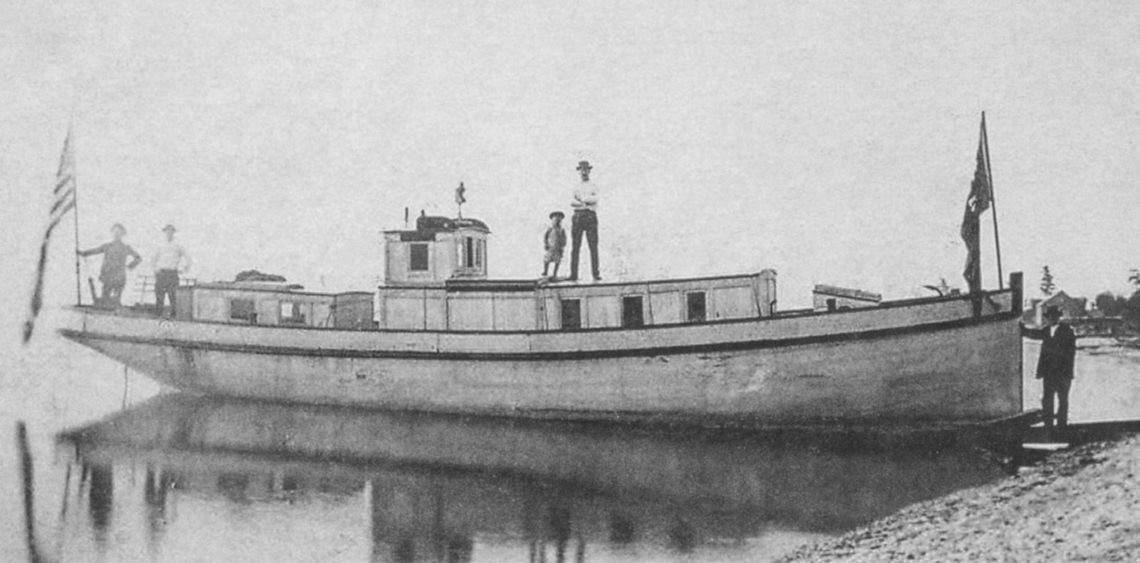
When the schooner O.M. Nelson was sold in 1888, Olaf Nelson and Lars E. Bahle considered buying or building a small steamer, but that partnership was not to be. Instead Lars Bahle commissioned boat builder Kristian Telgard, to help build a gas-powered launch for Bahle’s business around Grand Traverse Bay and for supplying fresh, farm produce and other goods for Bahle’s department store. In 1902 Lars Bahle and Kris Telgard began building the 55-foot (some sources say 60-foot) Emma in a shed on the Bahle Pier, and the next summer she was in service. The yacht, was named after Lars Bahle’s second wife, Emma Weir, whom Bahle married after the death of his wife Olene.
Lars and his son Esten took passengers on the Emma, for excursion to area ports, especially to Omena. Emma also made trips to High Island, part of the Beaver Island, to tow rafts of cedar logs to Peterson’s shingle mill and, perhaps, to other mills in Suttons Bay. She also carried cement from Elk Rapids, according to the newspaper Elk Rapids Progress,
August 27, 1903.
When a bad storm was blowing down Grand Traverse Bay in August 1903, Captain Esten Bahle learned of a yacht hung up on a reef off the lighthouse point of the Old Mission Penin sula. Heavy rain and lightening lit up the stranded Veya all afternoon and into the night, The gale threatened to destroy this yacht of George Winans, who had two other passengers with him.
Old Mission Point was usually visible off Suttons Bay, but it was night and storming when Captain Bahle commandeered the Emma away from Bahle Pier to the distressed yacht. It was a harrowing feat for both vessels, but before the night was over, Winans and his passengers were rescued, and the Veya was towed into safe harbor. George Winans was soon able to join friends and family at his cottage on Northport Point; and Esten Bahle and his gas-powered launch Emma gained respect as a passenger boat.