This continues a series adapted from the book, “A Port Oneida Collection,” Volume 1 of the twopart set, “Oral History, Photographs, and Maps from the Sleeping Bear Region,” produced by Tom Van Zoeren in partnership with Preserve Historic Sleeping Bear. Here we continue with the Baker Farm, at the north end of Port Oneida Road, next to Camp Kohahna.
In the Baker Barn, hay was hoisted with a hayfork hung from a pulley mounted high in the peak. The load was then swung out over the mows to either side and released. The hay then had to be spread to fill the mow.
The larger Burfiend Barn had a track running gable to gable (end to end), so the pulley could be hung from a trolley and moved along the track to better distribute the load in the mow. The Burfiends’ hayfork track was made of maple. Jack Barratt: “That was peculiar to me because most barns had steel tracks for the trolley.” As the Burfiends’ track dried out over the years it became twisted.
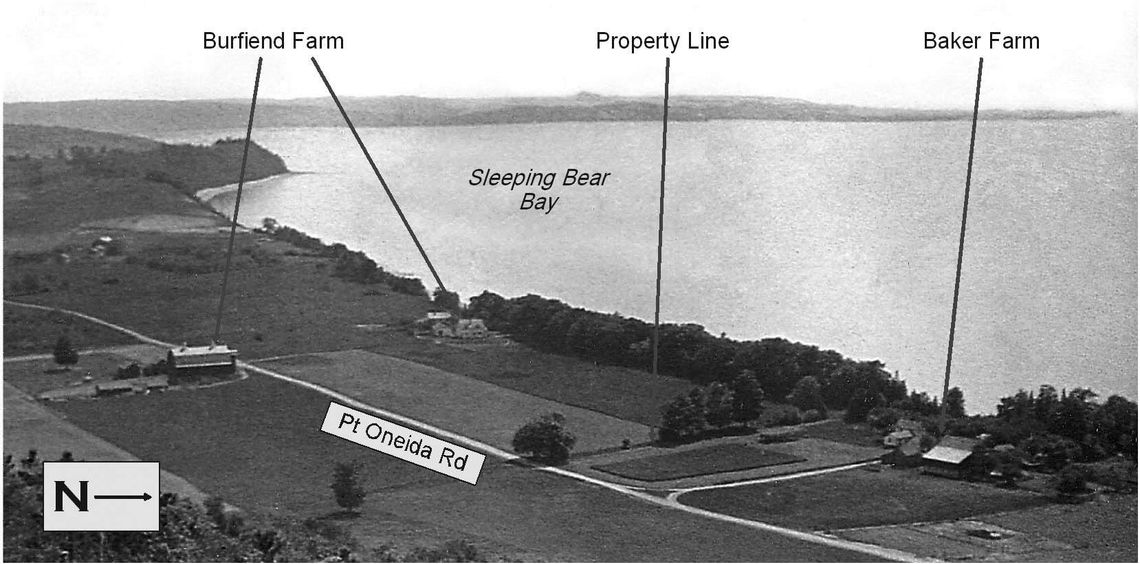
One summer Charlie Kropp, the Burfiends’ fix-it hand, built a “huge wrench out of wood with the right-sized mouth on it to put over that beam [the track]; and with ropes and a block & tackle we pulled that beam until it was straight and level.” They then secured it with a crosspiece fastened to the rafters. *** George Burfiend told the story he heard of the time Fred Baker rebuilt the fence between the Burfiend and Baker Farms, and moved the fence wires to the other side of the trees along the property line. “My grampa (Pete Burfiend) was, well, I guess you’d say he wasn’t as easy goin’ as my dad was, and Grampa really got mad about it. Of course Grampa said he never started a fight in his life, but everybody else always said he’d fight at the drop of a hat, and drop his own hat to fight. So anyway, he and Fred Baker got into it over there. Now Baker was a young man, and Grampa was an old man, and he looked pretty sad, I guess, after the scrap.”
Sometime after this incident, the Bakers awoke one morning to the “clink, clink, clink” sounds of the Burfiends girdling the large trees along the line (stripping bark to kill them), which provided shade in the Baker yard. “I cried for days,” remembered Fred Baker’s daughter Lucille. Hard feelings remained during the years that followed.
In 1933 Lucille and her good friend Myrtle Kelderhouse decided to get Port Oneida young folks together for a beach fire and a treasure hunt. One of those invited was Pete Burfiend’s grandson, Jack Barratt. Although Jack had spent all his boyhood summers on the Burfiend Farm, because of the feud he and Lucille had never really become acquainted. Wondering how to handle the situation, Jack went to his Uncle Howard, who had by then taken over the farm from his father Pete. Howard responded, “You let bygones be bygones. What happened 20 years ago has nothing to do with you. You go, and you drive the Buick over there!”
So Jack drove the Buick to the party next door, and won the treasure hunt, and more. The party was followed by an invitation to go for a moonlight horse ride along the beach, followed by other overtures. Although the two families had some trouble getting used to it (“What the hell, is she moonstruck?” asked Jack’s brother), Jack and Lucille married and shared 69 years together. The feud is ancient history. *** Here’s a Jack-&-Lucille story from a few years later: As the son of a Coast Guardsman, Jack naturally followed his father into the Guard after high school. Thus, Jack & Lucille spent two years stationed on South Manitou Island.
They recalled one beach patrol when Lucille accompanied Jack. As they sometimes did, they stopped for a swim along the way back. Jack: “When we got out of the water we grabbed our clothes and the clock and all the equipment, and we started running down the beach to dry off, you know; and when we started to dress, she had left her panties, and I had to run all the way back and get them.”
“Or he’d never have heard the end of it from the next patrol.”— Lucille.