Some showed up, others didn’t.
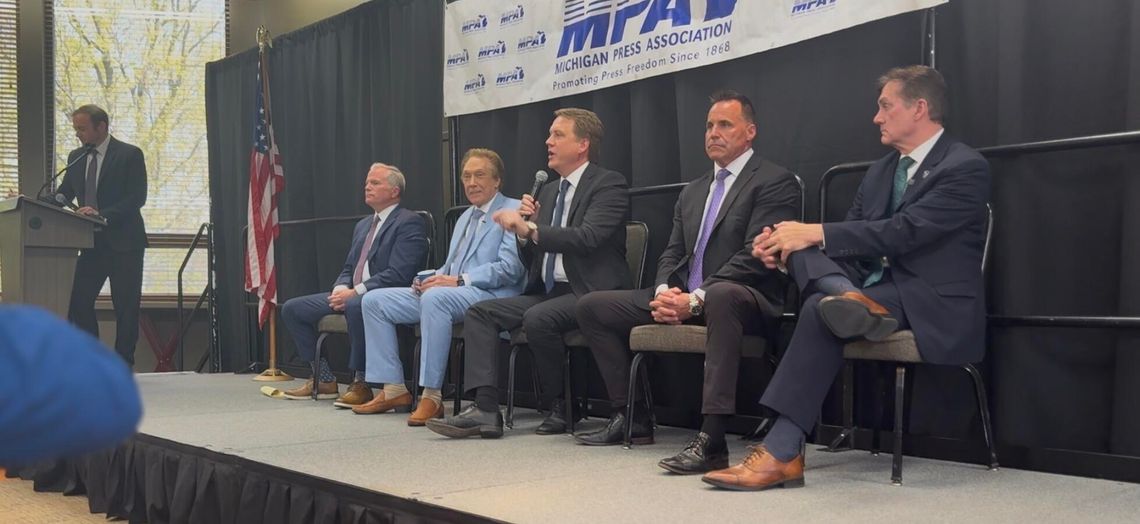
Several Republican and Democratic 2026 Michigan Gubernatorial candidates spoke at the Michigan Press Association (MPA) Luncheon last Thursday, April 23.
“At a time when voters are seeking clarity on key issues, bringing candidates together on one stage ensures a transparent and informative discussion on the policies and priorities that will shape Michigan’s future,” MPA said in a statement.
Former Genesee County Sheriff Chris Swanson was the lone democratic candidate flanked by Republicans on his left and right, including former state Attorney General Mike Cox of Livonia, Oakland County billionaire Perry Johnson of Bloomfield Hills, state Senate Minority Leader Aric Nesbitt of Lawton and Ralph Rebandt.
Democratic candidate and Secretary of State Jocelyn Benson of Detroit, and Mike Duggan, the former Democratic Detroit mayor running as an independent, were not in attendance. Republican John James was in D.C. during the debate.
Craig Mauger, the state political reporter for the Detroit News, moderated the debate.
Republican Tom Leonard dropped out of the gubernatorial race Thursday morning in a statement.
"As the race has evolved, we've taken an honest look at the path forward. And at the end of the day, I'm not willing to compromise who I am or how I believe this campaign should be run in order to win," Leonard wrote in a social media post. "Michigan deserves better. And right now, that means coming together, focusing on what unites us, and doing everything we can to move our state forward in November."
Questions at the luncheon debate ranged from local elections, FOIA, public notices, data centers, and housing, among others.
Plus plenty of jabs between the candidates.
Candidates gave a one-minute opening statement followed by a series of questions.
Opening statements
Mike Cox, the former attorney general, wants a Michigan miracle in his vision for the state.
“We are 44th in fourth-grade reading. …
We are striking out. And I'm running for governor to change that.
I'm a Marine, a former homicide prosecutor for 13 years. I was an attorney general who took on big issues.
Then, I became a small business owner, started with one employee, and built 25 jobs where everyone got paid, healthcare, and a good wage. I have two things to turn Michigan around. Number one, let's eliminate income tax,” Cox said.
”I announced this last March of 2025 because that's what the most prosperous states have done,” Cox said.
Cox wants to see a Michigan miracle in education, on par with the Mississippi miracle, which improved from the bottom of national literacy rankings in 2012 to near the national average by 2023.
“My grandchildren in Mississippi get a better education than kids in my neighborhood, Livonia, Michigan. That's a moral state. As your governor, we are going to turn that around,” Cox said.
Michigan currently ranks 44th.
Perry Johnson opening statement
Oakland County native and billionaire Perry Johnson’s favorite number is $4,747.
“I got my start in the auto industry at a time when I was struggling.
And I introduced the concept of statistical process control. We ended up going from having inferior quality to the best quality in the world. I mean, cut our cost by roughly 40%,” Johnson said. “I've been bringing quality and efficiency to companies my entire life.
I want to bring that to Michigan because I have one basic goal that many of you know. We are going to eliminate the income tax, and we are going to have $4,747 for every average family in Michigan. We are going to reform the property tax, and I'm going to do that without any new taxes because I am going to create efficiency.”
“If you were going to have heart surgery, you probably wouldn't ask an attorney.
And I wouldn't ask a neurosurgeon to do my hair … But I'll tell you this, I spent my life bringing quality and efficiency to companies, and I intend to bring it into our state government.
I intend to get rid of that waste, and we are going to have a better quality of life, and everybody's gonna have more money in their pockets,” Johnson said. “Every state that has eliminated the income taxes has prospered.
Let us prosper here. We once were the greatest state in the Union, let's get to that state again.” Johnson said.
Aric Nesbitt opening statement
“'I'm running for governor so that everybody can make it in Michigan.
Under the Democrats for the last eight years, there have been higher taxes, higher costs and a whole indoctrination of our kids. Giving free housing to illegal immigrants.
During COVID, I couldn't sit next to my wife when we found out we lost our secondborn due to miscarriage,” Nesbitt said. “I'm running for governor so these last eight years will never happen again. The first step is actually showing up.
Our current governor, Governor Whitmer, has not shown up. And we see Jocelyn Benson won't show up. I will show up as the next guy.
I'm going to show up to eliminate the state property tax. I’m going to show up and lower energy costs, rip out indoctrination in our schools, and stand with President Trump, to deport every criminal illegal from the state of Michigan,” Nesbitt said.
Chris Swanson opening statement
Chris Swanson, a former Genesee County Sheriff and Democratic candidate,, wants to make order out of chaos.
“33 years at the sheriff's office, seeing brokenness, pain, seeing people who struggle. I know that you can make order out of chaos.
I've seen it, walking with people, educating inmates, a water crisis, and people had no faith in the government. I'm going to love people unconditionally. I've been a paramedic since I was 20,” Swanson said. “I worked my entire life for this campaign.
For the last 14 months, I have 70,000+ miles and 1,300 events coming to places like this. Standing on the stage here as the only Democrat. But if we're gonna win an election, it's not just for my party. It's for the state of Michigan. That's why I’m the unity candidate.”
Ralph Rebandt opening statement
“I've been serving this state for 40 years. Every morning, I get up and look at a shampoo bottle that says, "wash, rinse, and repeat." The reason why it says that is because they want me to spend my money to make them wealthier.
Lansing has done the very same thing to you. If we keep sending people to Lansing, who are career politicians who haven't fixed the problem yet, though they say they can, we will keep doing the washrooms and repeat. There will not be a future for your children or grandchildren.
There won't even be an opportunity for the American dream. Many of us think that the American dream is on the verge of dying and being on life support. I'm going to take it off of life support by not just cutting the budget, folks, but we have a plan to reduce the budget, actually, to slash the budget on day one.
We have $12 billion. that we have found on our team to remove from the budget. So if you want an outsider who has no ties to the Lansing establishment, no ties to the special interest groups, who doesn't have to make a phone call first to find out if I can sign a bill. Ralph Rebandt is your candidate,” Rebandt said.
Q1: Some of the candidates on this stage have already asked the federal government to get involved in the administration of the upcoming Michigan Governor election. Do you support this idea?
And given the fact that Michigan's elections are run by hundreds of local clerks across the state, what specifically do you want the federal government or its agents to do in this election.
Johnson response
“I'm a great believer that you should have voter ID. I made that clear … I believe Congress passed a law that said, on the ballot that we're going to write on the ballot, it is illegal to vote more than once. And our governor vetoed that.
Now, I cannot understand her rationale for vetoing,” Johnson said.
Nesbitt responds
“Secretary of State Johnson Benson is the worst Secretary of State ever. She has sued more and lost more in court than any of the past Secretaries of State in our history. She's allowed Chinese nationals to rig our elections.
She refuses court orders. And once again, she doesn't even show up for the people. She's not even here today.”
“In the November election, we have the opportunity to pass an election law, that’ll update our Constitution. There are three very simple things.
One requires a universal photo ID to vote. Two, cleans up our voter rolls … and ensures that only citizens are able to vote.”
Swanson response
“We don't need the federal government in Michigan voting. We don't need ICE agents or federal agents at the polls. We don't need people who are scared to vote, whether it's in person or by mail. I trust and support the volunteers who are the eyes and ears of everybody in this room … We are being watched by the world. And our voting system, although it may not be perfect to some, it is trusted. Let Michigan run its own elections. Number two, there is no frontrunner. Not a Republican, not an independent, and certainly not a Democrat. The people on August 4th will determine who the frontrunner is,” Swanson said.
Rebandt response:
“What I'm looking for, in terms of the federal government, is that (Benson) has violated federal law … What I would be doing instead of going to the federal government, I would be looking for everyone in this room (reporters),” Rebandt said. “How come we are not cleaning up the qualified voter roll? That roll is so old, it's so corrupt. There are people who are voting that, yes, they are dead, and yes, there are 24 people at one address somewhere up and down I-75. But my point is, we have to have our people in Michigan hold our people accountable, and that's what I would want you to do.”
Cox response:
“I won the closest statewide race in 100 years when I was elected Attorney General for the first time (2002 over Gary Peters). During the informal county recounts that happened between the first Tuesday and the last Tuesday, 21 days later, Wayne County found 3,000 to 4,000 absentee ballots from the city of Detroit, literally in a bath.
Ultimately, I won by 5,200 and Peters didn’t do a recount. But it always stuck with me... And is it just an old problem?” Cox said. “
I'm going to make my win too big to rig. I'm the only guy who has won before. I'm going to do it again, regardless of what happens.”
Q2: We were expecting to have a sixth person on the stage, Tom Leonard, who dropped out of the race Thursday morning.
When he was running, he vowed to unilaterally sign an executive directive to open the governor's office to open records requests (FOIA). He called on all candidates to ask whether they would do the same.
Nesbitt response:
“It's just common sense. (FOIA) needs to be reformed in the state of Michigan.
There's no reason why you go into a city council, and you ask for some information, then come back to the $120,000 bill. You hear these cases around the state, and if we're going to have an open and transparent government, if people are going to trust institutions again, they have to be able to trust the governor, have to be able to trust the legislature, and I'm the only one here who has a record of actually voting or opening up. Not just the governor's office but also the legislature, and also working to make sure that it's easier for residents, for families, for reporters, for folks to be able to investigate,” Nesbitt said. “My pledge to you is I'm going to continue to work hard, not just on the campaign trail, but when I'm the next governor, to make sure we have an open and transparent government.”
Swanson response:
“To be unclear is to be unkind. And that's what happens when you have obstacles that give people the sense they can't trust, or they don't know.
The answer is yes … The process of being transparent allows you to do your job.
When you have nothing to hide, you have nothing to fear. When you make a mistake or there's some uncertainty, then straighten it out. But more importantly, when you have a nondisclosure grievance, and people are hiding behind that.
You destroy public trust. You see that with local data center developments. We have back-door deals being cut.”
Rebandt response:
”I would sign a bill that opens records in the governor's office in every department under my care. I've been saying this since 2022. When I first ran for governor, that was a part of my announcement speech here in Lansing. I am a Christian, and I realize that everything I do, everything I say is open and transparent before God. So why should it not be open and transparent before you?” Rebandt said. “I will be the most open, honest, and transparent governor you have ever seen, so much so that your children and grandchildren will want to become governor in Michigan. They won't be looking at the office as something that's just a scam artist. The other thing I wanted to say is about the nondisclosure agreement. I mentioned that several weeks ago. I will sign an executive order that anyone who signs a nondisclosure agreement under my administration will be immediately fired. I don't know about you folks in the press, but I am tired of Whitmer giving $155,000 in hush money, and I'm tired of Jocelyn Benson giving $700,000 to somebody to walk away.
I want to know where my tax dollars are going. That's why I'm the outsider running for this governor’s seat.”
Cox response
“The governor could be giving you all the information you're asking for. Any state senator or state representative could be doing the same thing voluntarily … (FOIA) requires public officials to give, but public officials can always give,” Cox said. “I'm going to open the governor's office to FOIA on day one … When I was attorney general, I created a site called TrackYourTaxes.com. where we put all our spending online, we put our vendor contracts online, salaries online.
Now, it wasn't as efficient as it would be now, but if I can order an Uber, and I know the name of the driver, what he or she looks like, their record long before they get to me … As governor, I'm going to make Michigan the most open state in America.”
“Duggan doesn't want to defend his FOIA record in Detroit, and Benson doesn't want to defend why she has to be sued to give the legislature public documents. So you guys make the choice. Thank you for that question,” Cox said.
Johnson response:
“The bottom line is that all of us agree that you have to have a fairly open government, but I'm going to try to explain to you why it's so critical.
You saw what happened in Minnesota, and they had all that fraud. We had a very interesting development. We noticed that there were (over 70) daycare centers that were getting money in Dearborn. We wanted to investigate that so we inquired about it. Now, the very next day, those sites disappeared from the Internet,” Johnson said. “Fortunately, we wrote them down. You have to see what happens in some situations that are bizarre. Let's take a look at what happened with the SPLC (Southern Poverty Law Center). We have a very interesting development where Benson was on the board at the time this happened.
They were funding the Ku Klux Klan and, at the same time, attacking the Ku Klux Klan.
When you have organizations that are charity organizations, government organizations, you need to know what's going on. If we don't do that, we're in serious trouble. We have to have the mega audit that I talked about. It's my intention that we end up with a clean government that doesn't waste money, because we're gonna know where that money goes … So let's be realistic. There isn't a single candidate here that doesn't think that's reasonable.”
Q3: Should the state stop issuing public notices and local notices in media outlets? This stems from recent law changes in other states.
Rebant response
“No, they should be on church doors, in newspapers, on the internet, Facebook, wherever they need to be. The public needs to know what's going on among the public, among the legislature, among life … I am looking for truth, and people need to be told the truth, and once they're told the truth, they will be able to deal with whatever's going on much better because people hate being lied to and being deceived.
And that's why I'm running for governor, I am tired of the corruption and we are going to fix that and straighten it all up,” ReBrant said.
Cox response
“Yes, much of rural Michigan, there are many people who still aren't connected, and they follow what's posted in the paper … (Public notices) is a minimal cost of a municipality, but it broadens the number of people who may encounter and become aware and can go speak to their government officials.”
Nesbitt response:
“I've been pretty consistent with that over the years.
I look at it, my dad, God rest his soul, passed away six years ago … he was one that was never on the computer, a farmer, three tours in Vietnam, and The Courier Leader that's how he knew what was going on. He'd sit there at the dining room table and read it This goes to the larger issue of how do you also make sure that you inform the public and also have an efficient and effective government?” Nesbit said.
Swanson response
“The answer is yes. I have been in the (FOIA) business for 33 years, operating on court orders, whether it's search warrants, arrest warrants, or trials … We don't want to take away what Detroit Legal News has been doing for decades. There's a reason people go to the paper; they go online … to support that method of communication only shows that we have nothing that's being held back. If anybody is trying to threaten (public notices) this news would not be reported, then they're on the wrong side of history on that one,” Swanson said.
Q4: The opposition to data centers in this state has become an organized, forceful, and has united rural conservative Republicans and progressive urban Democrats. There are very few issues capable of doing that. So in what ways would you, as governor, regulate and rein in data centers? And would you support an outright prohibition on those facilities' mission?
Ironically, Consumers Energy was a main sponsor for the MPA convention.
Cox response:
“The governor took away sighting decisions, battery power, and citing decisions for wind and solar. The local control has not been taken away regarding data centers. Every single community has the ability to put a moratorium on it. I'd encourage every single community to exercise local control, something we had, even before 1837, when we became a state. Rule number one is to maintain and continue local control. Let locals decide. There may be some locals who want it. There are roughly 70 data centers right now in Michigan, primarily in Metro Detroit, Grand Rapids and Alpena,” Cox said.
“If a local community decides they want to have, there's a second step to me, that if you want a piece of my pie, you have to bake your own pie, which means that a data center, in order to be approved, has to establish that it will build its own generation, so that we don't impact affordability, accessibility for any current customers right now in the utility … We don't want data centers coming into local communities or local businesses and ruining them in that regard.”
Johnson response
“It's important to understand that your energy bills have gone up dramatically. You had an increase just a few months ago, and they asked for another 8.1% and 6.1%, respectively.
DTE and Consumers Energy.
I'm thankful for Consumers Energy putting this on. Let's be realistic. This is unbearable. In many of the states, what they've done is they've forced the data centers to actually absorb some of the incremental costs. If they're going to make all that money, they should at least have to make an investment. We have various programs that we can have, such as requiring that you cannot have an increase in the energy cost rather than the rate of inflation.
You have situations that we have to recognize as tainted. Understand that Benson's husband is a salesman who is getting a commission on all these data centers,” Johnson said. “If you're going to have an augmentation of these data centers, the proliferation could be gigantic because the more centers we have, the more money invents its pocket. We have to have a way of regulating this and making sure that it makes sense.
Nesbitt response:
“The first thing with these big tech companies, I don't trust them. They have enough money. The first thing is that the government shouldn't be subsidizing them. I have a clear track record of opposing corporate welfare. We have to grow the economic garden.
And what we've seen from Governor Wittmer, and you'll see it more from Jocelyn Benson, is more of the same. Higher taxes for you, more money out of your wallet, more money for big corporations. $5 billion they spent on corporate welfare.
Over the last seven years, (the current administration) could have fixed every local critical condition bridge in the state of Michigan, three times over,” Nesbitt said. “The next governor needs to deal with data centers, and you do a few things, one, no government subsidies. Two, data centers need to be located in industrial zones. Enough eating up hundreds of thousands of acres of farm and forestland around the state, like what we're seeing from this green new scam.
Three, data centers should mean lower energy rates, not higher energy rates. They have the money.
It also means that they have to have a plan to protect our water. A fifth of the fresh water in the world surrounds Michigan with the Great Lakes…
It should also mean lower property taxes for folks around the state of Michigan, not higher property taxes. That's why I'm pushing to eliminate the state property tax, to make sure hard-working families keep more of what they earn, repeal the green new scam, and make sure hard-working families get lower energy rates.”
Swanson response:
“I'm not taking DTE money, Consumers money, grassroots is what funds this campaign. The problem with data centers is how it's been done. When you shove it down people's throats, and they don't have the ability to go to their local commission and have their voice heard, that's a problem.
When public service commissioners shut down public comment, that's a problem. When there are files that were given, that's redacted to the point where it has no value; that's a problem. When you're not answering questions of what the long-term impact is for that community,” Swanson continued. “They don't want to build anything and have the local community protest why it's happening. And that's what happened to Saline. When you try to take out hundreds of acres of trees in Kalkaska without asking people from Kalkaska, they don't want it, either. You and I have a place that we live and we want to be proud of it. We want our communities to be protected and to have this long-term investment.”
“We are going to divide the state into three colors. Yellow, red, green. Yellow, cities, villages, townships, counties, that have infrastructure, and a desire for manufacturing. They want to talk.
Red, no infrastructure, no desire. Leave us alone. Green, has infrastructure, we're open for business.
Now we are global competitors to people who want to come into Michigan. No tax incentives, no credits. Look at the people in Michigan.”
Rebandt response
“I am against data centers because everything I read about them in my research is that they corrupt our water, they corrupt the environment and they're noisy.
As with solar, as with windmills, now data centers, we get promised the moon.
I've talked with people who are township supervisors, city managers, people who have been told by these various industries that we are going to take care of you … And they never do. Look at their track record. All that it does is separate families; it separates neighbor from neighbor. They get angry with each other when someone sells out to the windmills,” Rebandt said. “All that it has done is create confusion and chaos in our citizenry. I do not want that.
As a governor candidate, I'm not against technology; I would still be riding my pony if I were. But the reality is, we have to make sure we are careful for the next generation to protect the environment for them, to protect their future, to protect integrity and honesty.”
“When you buy a home in a neighborhood or the country, you don't want something like that going in next to you. You want to have a voice, you want to be able to be heard.
And that's the problem, folks. We've gone from a debate community to a cancel culture community to an assassination community. That's where we are right now in our country, and we have to be willing to listen to each other to make progress,” Rebandt said.
Q6: One of the biggest issues here in northern Michigan is the housing issue. I want to know what your plan is to make sure that younger families can afford to buy a home at a reasonable rate. How do you address the housing issues – From Enterprise Editor Brian Freiberger.
Johnson
“Everyone knows how I'm addressing this issue. We are eliminating the state income tax. $4,747 in their pocket every year … There are programs with no money down, $4,747, extra every year is a huge difference. This is tax-free income … We need to make it a state where people want to live because they can have more money. We have to have a more favorable environment for business,” Johnson said.
Nesbitt response
“It's tough to make it in Whitmer’s Michigan, just talk to young families. They make an average of $9,000 less than the average family does nationally.
Yet the costs or expenses are a lot higher. The Michigan Homebuilders Association originally did a study saying, federal, state, and local regulations had $95,000 of cost for every new home. I don't know about you, but as a farm boy, $95,000 is a lot of money.
It adds up …
The average new home buyer, 39, 40-years old; 30 years ago, I was 28 years old (when I bought a home).
One, eliminate the state property tax. Lower property taxes, make it easier for folks to actually afford a home. Two, bring back the trades. For every five people retired from the trades, there are only two people replacing them. I think 25 years ago, we told a half a generation a lie that everybody has to go into college … but also, instead of giving free housing to illegal immigrants, that we've seen from Governor Widmer and that Jocelyn Benson is just going to continue.”
Swanson response
“It's so important for our next generation to be able to stay here.
Co-ops, like they did up in Marquette. They partner with local government, homebuilders, and investors to provide 200 affordable housing locations that may not always be single-family, it could be a condo. They did it up at the UP.
It makes sense.
The state of Michigan's got a serious problem. We are about 130,000 houses short. The majority of the houses in Michigan were built before 1980. You have to work with the Homebuilders Association; you commit to 10,000 new houses in the first 24 months. Just start somewhere … If we don't have part of the housing infrastructure built, how are we going to track new business? Infrastructure is not just roads, bridges, dams, and water lines. It's housing. It's the employment pool that people can draw from. The state has to be serious about being a partner with it …
As a reason why, there's no top runner in the Democratic Party. I make order out of chaos, as I said before, and one of them is homes … I can just tell you whether it's housing, economy, environment, manufacturing or public safety. The way I built my life is through leadership and finding solutions … Starting with 10,000 new houses in the first 24 months.”
Rebandt response
“First of all, we would be looking at removing the property tax completely. I hear my friends up here talk about $4,747. That will only work with people who are in a financial bracket that they're talking about, or a higher bracket, like millionaires and billionaires. That helps them. Removing the property tax helps everybody, from low-income zip codes to high-income zip codes.
What it allows someone who's a renter to get their rent lower. That's why I'm in favor of property tax removal because it'll help young people come into our state. They can see how beautiful it is.
The second thing is, we want to take the Michigan Public Service Commission's authority away from all of the stuff that they're doing that actually increases the state budget. We're going to remove that. We need people who are willing to say, as was mentioned earlier, we can't keep kissing the lobbyists in Lansing. If we keep going down that road, folks, it's wash, rinse, and repeat,” Rebandt said.
Cox response
“My parents both chose to come to Michigan for a variety of reasons. One of them was that homeownership was a hallmark of Michigan. Of all parts of Michigan, and we have to make that the case once again … 25% of the cost of every new home is regulation. So what do you need to do?
we have a DEQ/EGLE that is very slow to give wetland permits, for instance. Investors don't keep their money here … For every permit, for every license that people applied for, there's a clock. And if the government official doesn't meet the clock with a yes or no, the permit fee goes back to the applicant … Because capital moves quickly. And if someone can't get a permit from EGLE, they're going to invest in building homes somewhere else other than northern Michigan. The governor can lead a reform of the building code, which has so many extra rules that are really rooted in 50 years ago. The governor can do that. The governor can incentivize those communities that choose to embrace mini-homes or 3D-homes, to incentivize that in terms of revenue sharing.
We have to increase the supply. We can't have this Governor Whitmer, who's spent two billion more a year through (MSHDA), who now has not increased the homeownership rate at all. We can re-grab the homeownership rate in America.
And it will help folks not only in Livonia but also in Leelanau,” Cox said.