Historically somewhere between 10,000 and 11,000 people each summer visited the Manitou islands.
But that’s history. With ferry travel provided by Manitou Island Transit to the islands already canceled the visitor count this season might shrink into the hundreds.
While it’s been awhile since island visitation has hit more traditional levels — blame COVID, dockage problems at both islands and, lately, construction — ferry service continued unabated to North and South Manitou islands from 1917 to 2019. In 2020 high water made the South island dock unsafe while the North island dock was clogged with sand.
Construction of new docks is the stated cause of ferry shutdown this summer, although there’s more to the story.
Nels Carlson, a fifth-generation member of the Carlson’s Fishery family, laments on two levels. He’s concerned that other businesses that rely on Fishtown foot traffic will feel the loss. He is co-owner of Carlson’s Fishery, which occupies the building upstream of Manitou Island Transit near the mouth of the Leland River.
Having grown up spending summers on North Manitou Island, Carlson also feels for would-be visitors who won’t take in tranquil sunrises over the mainland or the overwhelming quiet of sleeping on a nearly deserted island. Most of the Manitous, which are part of Sleeping Bear Dunes National Lakeshore, is managed as Wilderness.
“It’s a shame that people can’t use it.
That’s my biggest thing,” he said.
Carlson added, “I’m not worried about the money we might lose; that’s not the end of the world. But those people who take the ferry might buy a lot of T-shirts and ice cream, so it will make a difference (to other Leland businesses).”
For a ferry service built on reliability, the past several years have been anything but routine with service to North Manitou in particular often disrupted.
Shoaling returned in 2023 to the National Park Service dock on North Manitou. The NPS constructed a $1 million temporary dock in 2024 that family-owned MIT deemed unsafe. That dock was removed while construction got underway in 2025 of a new permanent dock in a different location. Also this summer, a new dock is being built at the end of Cleveland Road within the perfectly round harbor at South Manitou.
Both new locations are where docks were originally built by early settlers and mariners, which might quiet critics who predicted problems for the NPS docks that are being deconstructed.
The lack of dockage in 2026 should lead to a brighter future for island visitation as the deserted villages on both islands are undergoing complete renovations.
“It’s all infrastructure,” said Scott Tucker, superintendent at Sleeping Bear Dunes National Lakeshore. “Water systems, electrical systems, septic systems, dock systems, and some work on historic buildings as well.”
Tucker said weather was a factor in delaying completion of work on the North island. Spence Brothers, a statewide construction company with plants in Traverse City, Saginaw and Ann Arbor, is the general contractor.
“The plan was to have it completed before last winter, but the contractor was not able to finish the work. Hopefully both islands will be completed this fall. The contracts stipulate to have work done by Dec. 31, 2026,” Tucker said.
MIT ran a popular day trip to South Manitou that gave noncamping visitors a feel for island life and the rich history of the island, which was settled before the mainland. The company, which is owned by the Munoz-Grosvenor family that was awarded a federal mail contract in 1917, also offered a guided road tour that was canceled.
“A big piece of the day trip was visiting the village, which is closed. It will have six-foot trenches this summer for infrastructure. The village is closed so contractors can get their job done as efficiently as possible,” Tucker said.
Despite the lack of ferry service, Tucker said island visits are possible by private boat or by contracting with Manitou Passage, LLC. He reminded visitors that they’ll need to buy a back-country pass.
Park island staff will remain at past levels, Tucker continued. Each island will have two maintenance workers, while three rangers will share duties for both Manitous. In addition, research and wildlife projects such as protecting piping plover nesting will continue.
Manitou Passage is co-owned by Jimmy Munoz, who is also a principal in Manitou Island Transit, and Geoff Niessink. Niessink is a member of the Grosvenor family and chairperson of the Leland Harbor Commission.
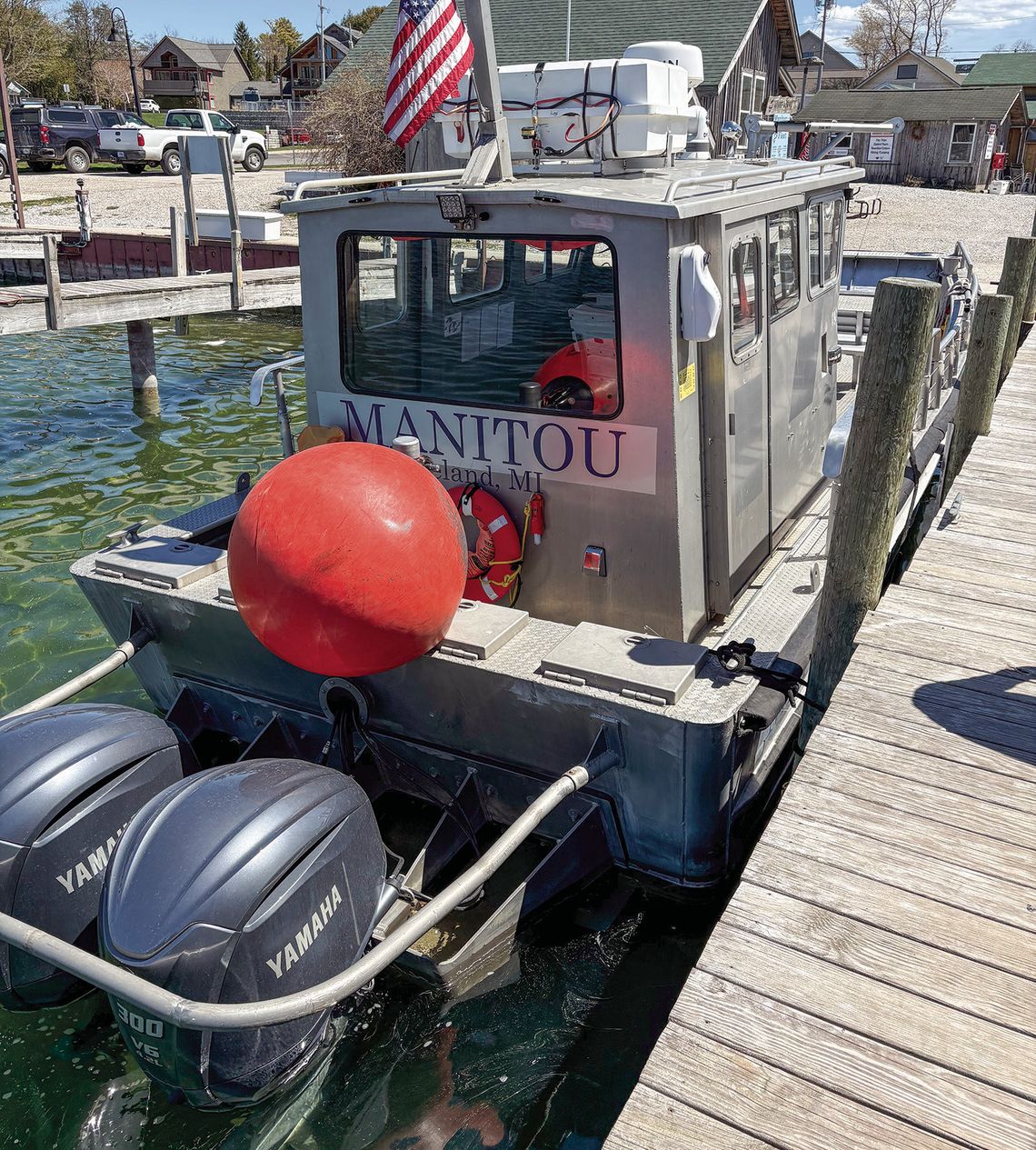
Manitou Passage owns two landing crafts, the Bear that holds 12 passengers and the Manitou with a capacity of 25. Prices for trips vary on factors including the size of groups seeking transportation. Adult prices to visit South Manitou aboard the Mishe-Mokwa ferry were $45.
“Obviously, because we won’t have as many passengers, it’s going to be more expensive,” Munoz explained. “It will be need based, mostly on weekends and maybe once during the week.”
Manitou Passage offers the only passenger carrier boats licensed by the National Park Service, which has designated specific areas for beaching that pose no danger to nesting piping plovers or rare pitcher’s thistle plants. Both are listed as endangered species.
The company works closely with the North Manitou Light Keepers and the Fox Island Lighthouse Association, nonprofits that are restoring historic lighthouses in the Manitou Passage.
In past reports, Munoz worried about the future of Manitou Island Transit, which won a civil lawsuit to recover losses suffered when dockage problems shut the business down in 2020. When interviewed for this story, he chose not to discuss viability of MIT to sustain another shutdown.
Tucker, when queried, said the park vendor license issued to MIT has been suspended while docks are rebuilt but otherwise remains in place through 2029.
And Carlson had a hard time understanding why the old docks couldn’t be used while the new ones are built.
“I think it’s pretty silly that they can’t figure out how to keep those docks going,” he said. “It’s not real complicated. If the dock is there, they could get off in the sand and walk around.”
Island visitation via ferry has varied greatly over the past four years:
• 2025: South Manitou 6,690, North Manitou zero;
• 2024:South Manitou 8,251, North Manitou zero;
• 2023, South Manitou 9,083, North Manitou 617;
• 2022, South Manitou 6,427, North Manitou 3,971.