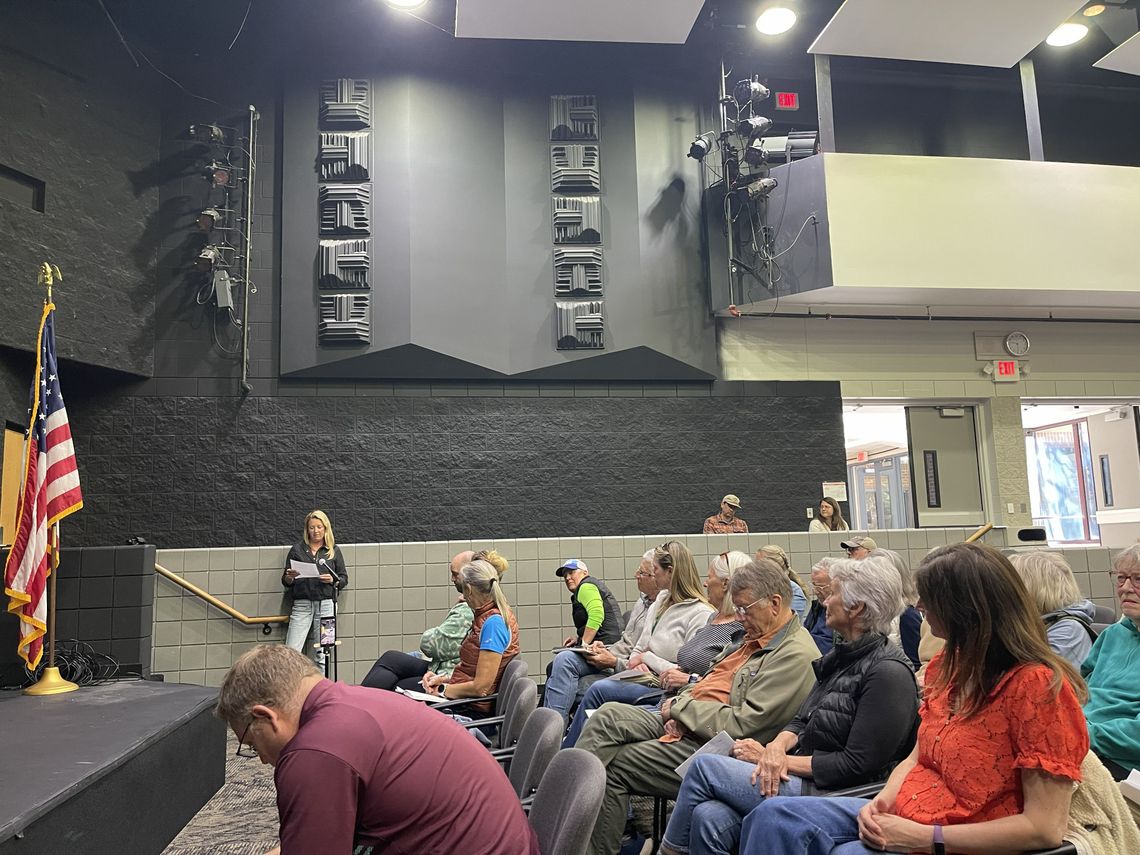
Leland community members had the opportunity to share their frustrations and concerns regarding Hancock Field designs and improvements currently in the works at a Leland Public School Board of Education (BOE) special meeting held Wednesday evening.
Hancock Field is on property owned by Leland Township, however, the school has use of portions of the park through deed. Leland Township has been working through the design process for improvements of the park property since last year.
The Leland Township board and Leland School BOE were set to hold a joint workshop meeting on May 20 to further review and discuss Hancock Field plans, however, Leland Superintendent Ryan Huppert said the township chose to cancel and opt out from it last week due to plans being “non-negotiable.” The school board chose to continue its scheduled meeting despite the absence of the township’s participation. Two township board trustees, Greg Kuntz and Steve Scales, attended the meeting as members of the audience though.
The school presented its recommendations and priorities for Hancock at the well-attended meeting, making clear that they have tried multiple approaches to encourage the township not to create a second separate set of pickleball courts by paving over existing field space.
Huppert said in an email sent to school families on May 19 that the school has a deep interest and a long running investment in the field because of how heavily it is used by their students, teams, families and community. During a typical spring practice day at Hancock, the school reports that girls soccer, varsity track, middle school track, St. Mary’s baseball, and Leelanau Soccer Club youth are all utilizing the park and its amenities at various times.
The school’s goal has been to advocate for the continued availability of open field space while also trying to collaborate with the township on any future improvements.
“As far as we are aware, the township is planning to move the little league/softball field to the middle field, which is the old baseball field location, and then pave over the area where the current little league/softball field is located to create an additional set of pickleball courts,” Huppert said in the email to school families. “The limited field space at Hancock is highly valued and heavily used, and we do not believe it should be paved over when other options exist. We are not opposed to additional pickleball facilities if the township determines they are important, but we strongly believe they should be located as an addition to the area where the current pickleball courts already exist.”
To avoid the paving over of more field space, Huppert said the school offered an alternative, to revert the deed of jurisdiction for the existing pickleball court area back to the township, since they currently have a deed of jurisdiction over that area. Huppert said the township declined the school’s offer and stated that its plans were non-negotiable, despite the school’s attempts at collaboration. Huppert said he was also disappointed to learn that other township board trustees were not made aware of the school’s deed proposal.
“The significance of that (deed) offer, I thought, was enough that it would be shared with the remainder of the trustees and that didn't take place,” Huppert said. “That’s actually where we decided maybe it's best if we try to have a workshop format where our board can sit down with their board, everybody all in the same room and you folks there with us and have a good, open public dialogue on this because things get lost in translation or don't get shared and that just slows everything down and frustrates people.”
Some of the school recommendations for Hancock included improving and restoring the soccer field in its current location and investing in repairs over the coming seasons. The school also highlighted maintaining the little league/softball field in its current location and were opposed to relocating the little league/softball field in order to build new pickleball courts in its place. Preserving the middle field and dugouts while supporting the grandstand removal or refurbishing it was also part of listed recommendations, as well as creating a cross-country running trail within the wooded perimeter of the property.
A number of Leland community members spoke during public comment about the significance of Hancock and cited frustrations with the township board’s handling of the planning process.
Leland resident Jane Keen said she previously served the township as clerk and deputy clerk for 20 years, and that they’ve always considered Hancock to be a jewel. When she was on the board, she said there was always an amazing feeling of cooperation between the school and township. Keen described how she has never seen this kind of “uncooperative spirit” happening now between the two entities in all the years she’s served.
“There seems to be such angst right now, it doesn’t need to be this way. We really are all here for our children, for the beautiful area that we have that we want to preserve, and if it takes showing up at township meetings to let people know that this is what we want as the citizens of this community — we don’t even have a maintenance man anymore to take care of Hancock Field,” Keen said.
Lauren Connor, a Leland parent and registrar/vice president for the Leelanau Soccer Club (LSC), also spoke during public comment about how the hundreds of students in their program utilize Hancock Field every year. She noted that the creation of a permanent structure like pickleball courts would eliminate the outfield space that the club uses for youth programming on the soccer field.
“The use of Hancock is essential for keeping kids in Leland and throughout the county engaged in the sport and allows us to continue to help develop the love for the game as well as a chance to develop friendships and community across our county,” Connor said at the meeting. “While overlapping soccer fields with one another is a possibility in some cases, the current number of LPS students, LSC players, as well as St. Mary’s middle school baseball players who currently use the open green space all at the same time require use of all of the area, us finding alternative field locations, or reducing our programming.”
Another member of the public and township planning commission chairperson, Lee Cory, commented on the issue, citing concern for the township’s behavior not only regarding Hancock, but other township matters, too.
“The township board’s stated position that Hancock Field is non-negotiable is evidence of a disturbing pattern of behavior that has emerged over the past 18 months,” Cory said. “This pattern is evident not only with Hancock Field, but also in their positions on the Old Art Building overlay district and the Apollo’s application of the special use permit… The township’s behavior has long-term consequences not only for Hancock Field and for Leland school, but also for the entire community for generations to come. We should shine a light on this behavior and address it.”
Leland Township Supervisor Clint Mitchell said what's "non-negotiable" is the elimination of the baseball field, and explained that the board has heard many concerns from both long-time residents and parents of baseball players on the importance of a full-sized baseball field. He said that the board listened to those concerns and determined that keeping the field was in the best interest of the township from both a practical and economic standpoint
“It can be used for all ages from pee-wee to high school, and costs about $200,000 less for some repairs to the infield — the dugouts and fencing are in good shape — vs. the cost of renovating the little league field. The field can also double as practice space for other sports, and serve as the location of the ice rink,” Mitchell said in an email. “We asked the school to respect that position as they move forward with their plans. They did not.”
Mitchell said as for the current little league field, there are some unsafe structures that need to be removed, adding that they plan to address that in 2027.
“At that point, if we see financial support from the amenities residents have asked for — playground, basketball courts, pavilion, pickleball courts, picnic area — that’s the logical place for it,” he said. “It’s a triangular corner piece, less than one acre of a 15-acre park. It’s isolated from the rest of the fields by its elevation, has direct access to street parking, and is well-buffered from adjacent residents by trees and distance. We asked the school’s plans take that into account, as well. They did not.”