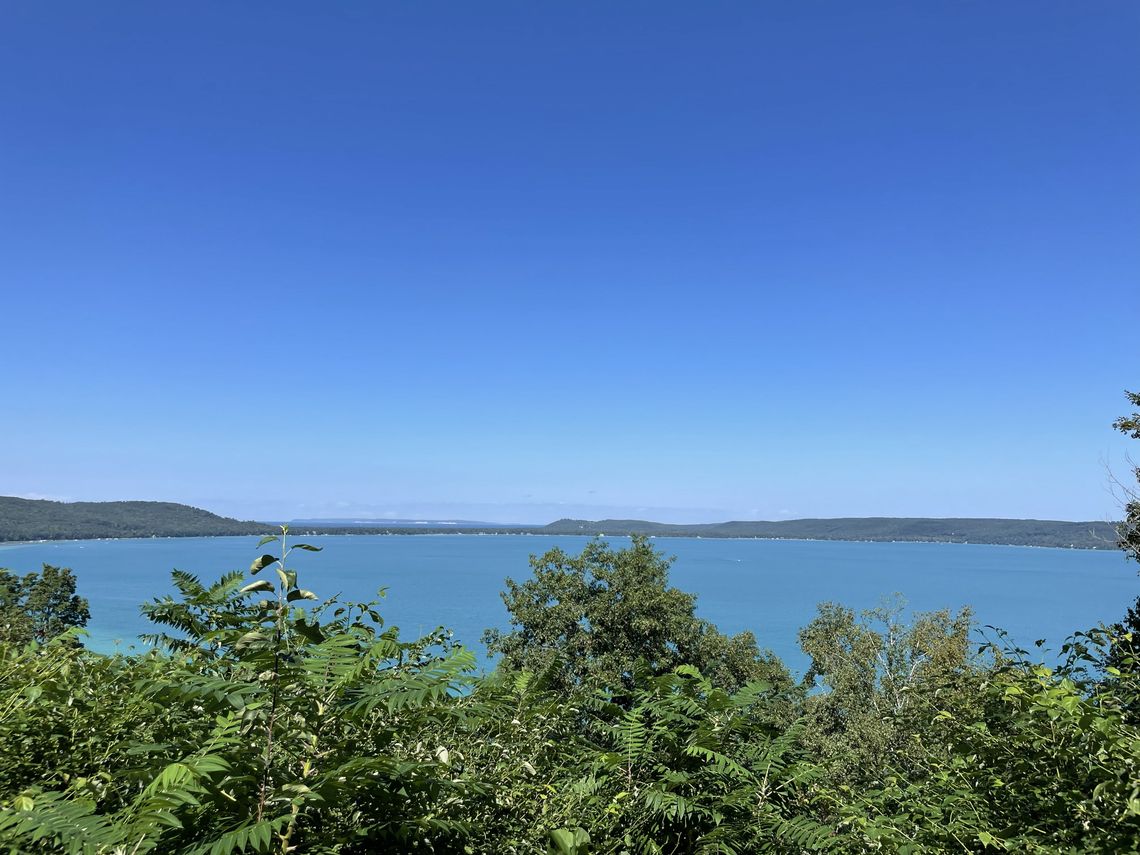
For some waterfront property owners, a shoreline crowded with wild vegetation might not be as
appealing as a beautifully manicured lawn, but those plants are doing some of the most
important work to keep Leelanau County’s inland lakes so beautiful.
“We say that protecting water quality starts at the shoreline,” Glen Lake Association (GLA)
executive director Kate Gille said.
Native shoreline plants serve as a lake’s first line of defense against pollution and erosion by
creating a buffer zone or “greenbelt” that is at least 10 feet of natural vegetation. Deep rooted
plants and aquatic vegetation help slow stormwater, trap sediment and nutrients before they
enter the water, stabilize soil with deep root systems and create habitat for fish, amphibians,
birds and pollinators.
“Overall, the shoreline health of the Glen Lake/Crystal River Watershed is in good condition,”
Gille said. “But as the majority of the lake shoreline is privately owned, it depends on the good
stewardship of the community."
That reliance on private landowners is why education is a core function of the GLA. Gille
explained that the goal is not to regulate shoreline choices, but to give property owners the
information they need to make the most informed decision possible, as humans continue to be
the greatest pressure on lake health.
“The more our riparian owners know about water quality, the better land management decisions
they can make,” she said.
Shoreline surveys conducted by the GLA help track those changes over time, documenting
everything from greenbelt coverage, which has remained stable, to shoreline hardening
techniques such as riprap and beach sanding, both of which have shown increased use in recent
years.
“Sea walls or other ‘hard armoring’ like riprap might seem like a good solution for stopping
erosion; however, these hard surfaces can reflect wave energy, which causes worse erosion on
adjacent shorelines,” Gille said, adding that they also hurt wildlife habitats and reduce the
shoreline’s ability to filter runoff. “A natural shoreline is the gold standard in terms of water
quality protection.”
Gille described a healthy shoreline as a layered system including canopy trees, shrubs, native
grasses and aquatic plants along the water’s edge. When those plants are removed or replaced
with turf grass that extends to the water’s edge, runoff can increase and nutrients like
phosphorus and nitrogen can easily get into the lake. Once in the system, those nutrients
accumulate over time and can degrade water quality in ways that are difficult to reverse.