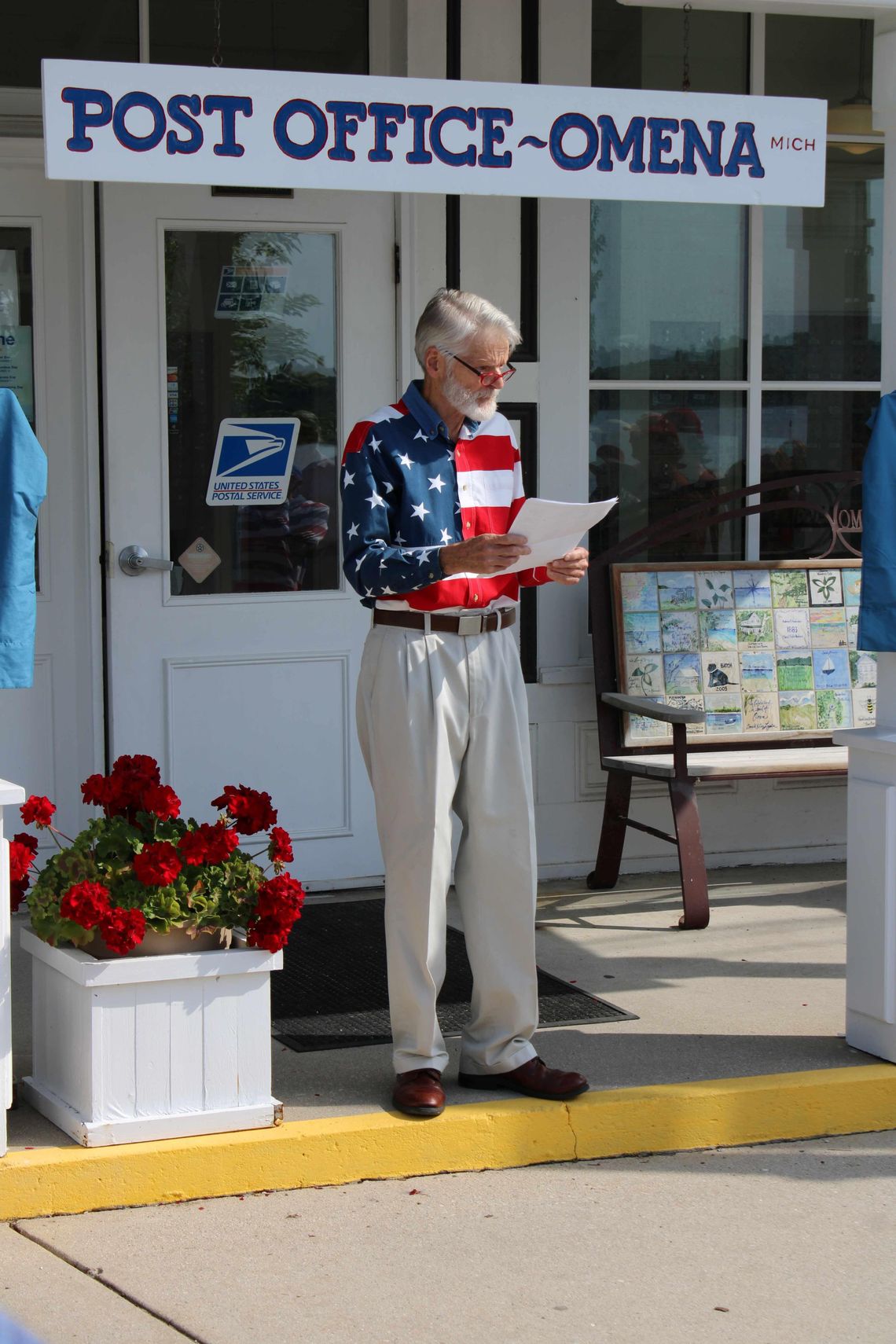
For the 13th consecutive year at the Omena post office — and the 11th year spanning all nine Leelanau county locations — Rink Smith and several other patriots will lead readings of the Declaration of Independence on the Fourth of July, beginning at 10 a.m.
This year marks the 250th anniversary of the Declaration's adoption, and Smith noted the coincidence with a laugh.
"I hadn't thought of the poetic justice there," he said. "The 13 original colonies, here on the 250th birthday, my 13th year."
Smith started the tradition after picking up the back page of the Leelanau Enterprise in 2014 and was struck by the gravity of the document. He hung a notice at the Omena post office that first year announcing he would read it aloud for the Fourth of July.
"There were two friends and family that showed up that first year," he said. "The second year, we had a little more fanfare with a dozen or 20. Then Jim Anderson came along, and now all post offices have a reading of the Declaration of Independence."
This year, readings will take place simultaneously at 10 a.m. at post offices in Omena, Northport, Suttons Bay, Leland, Lake Leelanau, Cedar, Glen Arbor and Empire.
Smith said the milestone has him returning to the document with fresh eyes.
The line that stays with him most is the declaration's closing pledge — that the signers mutually committed to each other their lives, their fortunes and their sacred honor.
He also pointed to a passage from the second paragraph that consistently stands out regarding the wisdom required before breaking with an established government.
"Prudence indeed will dictate that governments long established should not be changed for light and transient causes," Smith quoted. "Our forefathers were not doing this for fun. There was a lot of sacrifice involved. And yet they proceeded, because the gravity of the abuses had gotten so weighty that they could no longer hold back."
Smith said readers of varying political backgrounds participate each year across the county, and he believes the document speaks across the modern divide.
"Modifying the definition of consanguinity to focus on our common ancestry of American values as expressed in the Declaration of Independence, I submit that our extreme polarization could be mitigated if we would all revisit and rehearse this 250-year-old document," he said.
Longtime Northport reader, Paul Sloan, won't be able to make it this year — his daughter, a fiddle player, has been invited to perform in Nashville.
That doesn't mean Sloan has stopped thinking about what the anniversary means.
"It really calls upon us to reflect on the events that occurred those many years ago, and their relevance to our current times and lives," he said. "The deeper you get into what is known about that day and those events, the more relevant it becomes and the more interesting it becomes."
He pointed to the vote itself, which is often misremembered as unanimous. Each of the 13 states ultimately voted for independence, but individual delegates within those states were divided. Among the dissenters was John Dickinson of Pennsylvania — one of the most prominent voices who believed the colonies were not yet prepared to take on the most powerful nation in the world.
"They needed to settle disputes that existed among themselves first, and get a better sense of whether they could hope for an alliance with France," Sloan said. "None of those things had been resolved when we declared independence."
And yet when the vote was taken, Dickinson accepted the result as the voice of the nation, put on his uniform and led a battalion to New York to support Washington.
"Being dissenting or disagreeing does not make one not a patriot," Sloan said. "In fact, that's what this wonderful country is all about. Sometimes that is lost in today's contentious dialogue."
When asked which section of the declaration rings most true in 2026, Sloan pointed to its opening aspiration — that all men are created equal and endowed with the unalienable rights of life, liberty and the pursuit of happiness.
"Those lines are such an incredibly elegant, eloquent statement of who we are, that they have endured for 250 years and ring as true today as they ever did," he said.
He acknowledged the document's fundamental contradictions — Jefferson himself enslaved people, as did the majority of the delegates — but said that tension doesn't diminish what was written.
"What he did do was give us an eloquent aspirational statement that we continue to strive toward," Sloan said. "The founding fathers handed us a baton to continue the race, and every generation has continued it."
He also encouraged anyone reading the declaration this week not to let their eyes glaze over at the long list of grievances against King George. Some of them, carry a surprising resonance today.
"Read them and think can any of these things still be relevant?" he said. "You might say, my goodness, some of them still are."
Smith said his long-term hope is to expand the readings beyond Leelanau County — regional, statewide, eventually national.
Readings begin at 10 a.m. Saturday at post offices across Leelanau County.
Doug Whitley, a Northport resident, will step in for Sloan at the Northport post office this year.
He has read the declaration roughly 70 times since May in preparation, and has already arranged something new for the occasion. The village will block off the road in front of the post office for 45 minutes during the reading. Northport typically draws around 50 people, and he is looking forward to guiding them through what he sees as a layered document most Americans only skim the surface of.
"The declaration is in three parts," he said. "There's a preamble, 27 grievances against the king, and then for me personally, the best part is the end — when they write 'the representatives of the United States of America.' That's the first time that phrase appears anywhere in the document. Throughout the rest of it, the references are just to the colonies."
Whitley added that the trickiest part of reading the declaration aloud is Jefferson's vocabulary — words like consanguinity, perfidy, usurpations and magnanimity that were common in the 18th century but trip up modern readers.
His favorite line, and the one he hopes carries the country another 250 years: governments derive "their just powers from the consent of the governed."