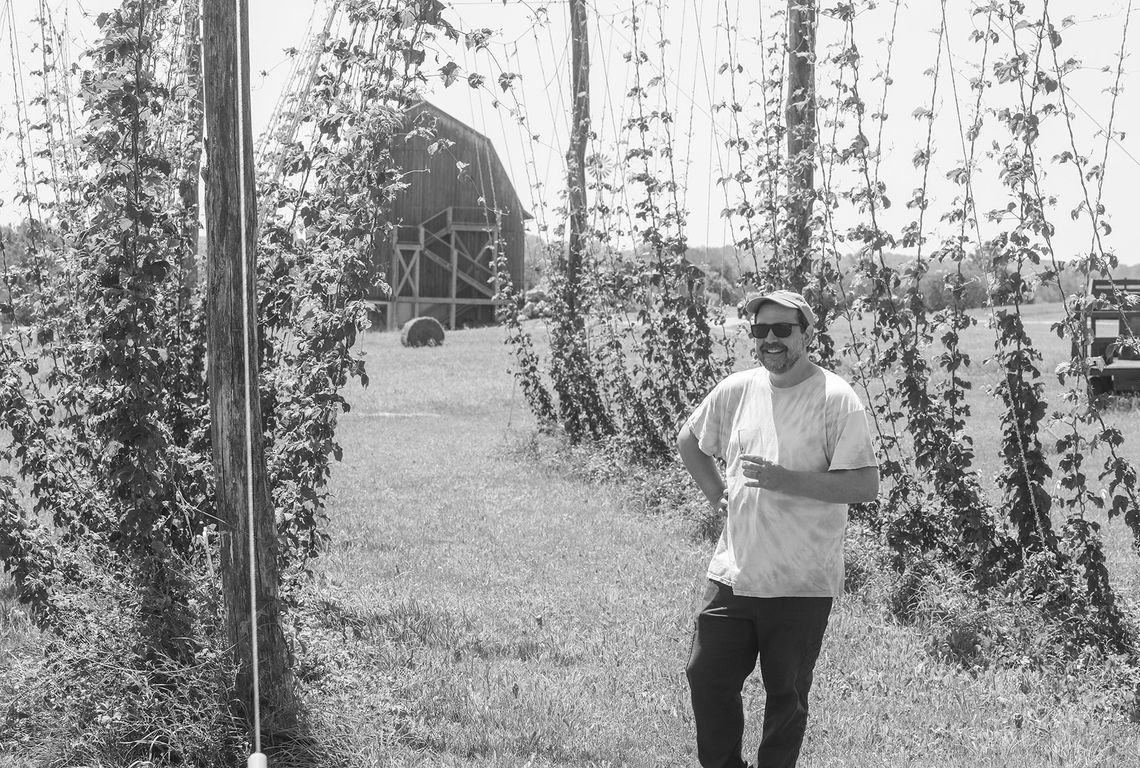
“We’re first and foremost a winery, but we do have some estate-grown hops, and we’re trying to incorporate that more.”
French Valley Vineyard’s tasting room has poured wine since it opened in September 2020, but the beer is the new kid — brewing began just three years ago, and the man now steering the program is Andy Savina, who took over the program last August.
Savina isn’t new to the area’s beverage scene. He’s been in the industry since 2013, starting out at what was then Brengman Brothers — now Brengman Family Estates — where he first got to know Harmony Estates head winemaker Blake Lougheed.
“An opening came up while I was working at Short’s at the beginning of last year. Took a little bit to work it out, but eventually came over here.”
That dual background shows in how Savina talks about the operation.
“I like the idea of working both sides of the business here,” he said. “The wine is really where I started. I got into the beer when I went to work for Short’s, so it kind of fit perfect with my experience.”
Estate hops, one beer at a time
The vineyard’s own hops are still a small part of the operation.
“We had only one beer last year that used our estate hops,” Savina said. “It’s basically enough for like one beer.”
That beer — a hazy IPA — was racked last week.
“We racked our hazy IPA, the first of its kind here,” Savina said. He expects it to release by the end of the week, pending carbonation.
“We’re settling into some of our personal favorites,” Savina said.
What’s pouring now
French Valley currently has three beers on tap, plus a seltzer in the works: Pilsner — “Straight pilsner malt, about as simple as a beer can get,” Savina said. “It’s a great beer.”
Amber Ale — “More of like an Italian style as opposed to an Oberon,” he said, “more emphasis on the caramel maltiness and less so on the hops.”
Black Ale (schwarzbier-style) — Savina’s personal favorite, and the brewery’s second batch of it.
“It’s basically pilsner with a whole bunch of black malt in it,” he said. “It gives you the same ballpark as a porter or a stout, but 5% alcohol, very dry” and drinkable, in his opinion.
Sourcing local
Savina said the brewery is committed to all-grain brewing.
“We’re trying to buy as much local as we can,” he said. “Buying all of our malts, hopefully, from Great Lakes Malt Company. Hops are a little harder to source completely local.”
The brewery currently runs one 37-barrel tank and two 10-barrel tanks.
Savina believes the beer program is a part of a bigger pitch for the vineyard.
“We’re trying to give the agricultural experience. That was the idea of throwing the brewery on top of the vineyard,” Savina said.
He said he’s aiming for something approachable rather than extreme.
“I’m not trying to knock anyone’s pants off by how much hops are in a beer,” Savina said.
Even the hazy IPA, a style he called “a little outside of my palate,” has found its audience. “People like it.”
Savina, originally from Grand Haven, first came to the area in 2009 to work a farmer’s market farm job.
“It kind of got stuck in my head how awesome it is up here,” he said.
He later spent time in California’s medical marijuana industry during the “Green Rush” before the shifting landscape of that business pushed him elsewhere.
“I made the connection between grapes and marijuana really quick,” he said, crediting a culinary and baking back- ground with easing the move from bread to wine.”
Harmony Estates winemaker Blake Lougheed talks cherry wine and more
A regional specialty:
Lougheed wanted to make one point clear about cherry wine specifically: it’s a niche few wineries anywhere else in the country can fill.
“We’re growing a massive portion of the country’s tart cherries in our area,” Lougheed said.
Unlike grapes, which can be shipped or bought as bulk juice from West Coast producers, fresh cherries don’t travel well once picked at the peak of summer heat.
“There’s only a few places in the country that can make cherry wine fresh — pressed the day they were picked. We have a unique opportunity to do that,” Lougheed said.
He called cherry wine “not for everyone” — typically sweeter than a table wine — but said it functions as a genuine regional novelty for visitors.
“If they go back home to wherever they’re from, you basically can’t find cherry wine,” he said. “It’s a unique product that we have up here compared to the rest of the country.”
Lougheed knows the cost of cherries will be a little higher this season with a lower crop and a higher price.
But Lougheed said the price spike won’t hit bottles as hard as it might seem.
“In wine, the fruit component is only a fraction of the total cost,” he said. “Only maybe 10-ish percent of the cost of a cherry wine bottle is the fruit itself. So if that price doubles, it’s not like the cost of the product’s going to double — instead of a $16 bottle, it might have to be $17.”
He said Harmony Estates plans to make cherry wine in normal volumes this year regardless.
Cherry harvest lands in what would otherwise be a break for winemakers between the end of bottling season and the start of grape harvest, Lougheed said — and the fruit itself fights back more than grapes do.
“They’re very hard to press compared to grapes,” he said. “A grape is pretty easy to squish. Cherries are a little more firm — they hold onto their juice, but they also have those pits in them.”
Standard crush-and-de-stem equipment used for grapes doesn’t work for cherries, requiring separate equipment, and a more labor-intensive process.
Heat adds another layer of urgency. “We can harvest grapes and it might be 40 degrees out — it’s like harvesting in a refrigerator,” Lougheed said. Cherries, by contrast, come in at 90-plus degrees and can’t sit. “You can’t just let them sit out for a day. Otherwise they start to ferment themselves before I get a chance to put the yeast I want in there.”
Lougheed said the Bel Lago tasting room has largely avoided the staffing struggles other hospitality businesses have faced.
“We happen to provide a job to people that kind of like being here,” he said, noting many tasting room employees return summer after summer.
The vineyard side is a different story. After years of difficulty finding local labor, Harmony Estates now relies on federal H-2A workers brought in from Mexico. “It’s pretty expensive, but it’s at least guaranteed labor,” Lougheed said. The vineyard has access to roughly 10 to 12 workers who often split time helping other wineries across the peninsula as well. “It works out for everyone,” he said, adding that many of the same workers return year after year, some for their third or fourth season.
Asked how the 2026 grape season is shaping up, Lougheed said it’s simply too soon to know.
“If you asked a corn farmer, he could look out there and say, ‘yep, we’re 36 inches up, we’re going to harvest in a few weeks,’” he said. “Grapes — we still have three months to do most of the work. It’s not really at a point yet that we could say one way or another.”
He said a bad year reveals itself early through frost damage or poor fruit set, the way this year’s cherry shortfall became clear before harvest — but a good year isn’t confirmed until much closer to September.
“Let’s just hope and assume it’s going to be wonderful,” he said.