The following is an excerpt from “Suttons Bay, Peshawbestown and Bingham Shores on Grand Traverse Bay” by Kathleen Firestone.
This and other books by Firestone can be purchased at local book stores.
Suttons Bay, Peshawbestown, and Bingham Shores on Grand Traverse Bay. 1850s Suttons Bay is a perfect example of how early settlers built docks, docks brought commerce, new businesses were established, and the town grew to add young families while still keeping names of its pioneers.
Before any white settlers came to live in the Suttons Bay area, the Leelanau Peninsula was governmentally attached to Grand Traverse County. The first land survey was as early as 1839; and after a re-survey, Suttons Bay and Bingham were included in the larger township of Centerville, in 1856.
In 1863, Leelanau was detached from Grand Traverse County, and the Suttons Bay and Bingham settlements and outlying acres became the township of Bingham and shared Leelanau County with eight other townships.
When the bigger Centerville Township was still in place, government surveyors noted, “The southwestern portion of this township is hilly and broken. The northern and eastern portions are somewhat elevated but level on the summit. The soil is generally of excellent quality and timbered with sugar maple, beech and elm. Nearly every section in the township is well watered with small streams and springs of pure water. The swamp noted in Sec. 33 is mostly timbered with white cedar, affording a large amount of fencing material. Soils is a rich black loam and would make, if cleared, excellent meadow.”
It’s obvious that surveyors saw the monetary value of timber and how it could help build communities, and the newly cleared land would be suitable for homesteads and farming.
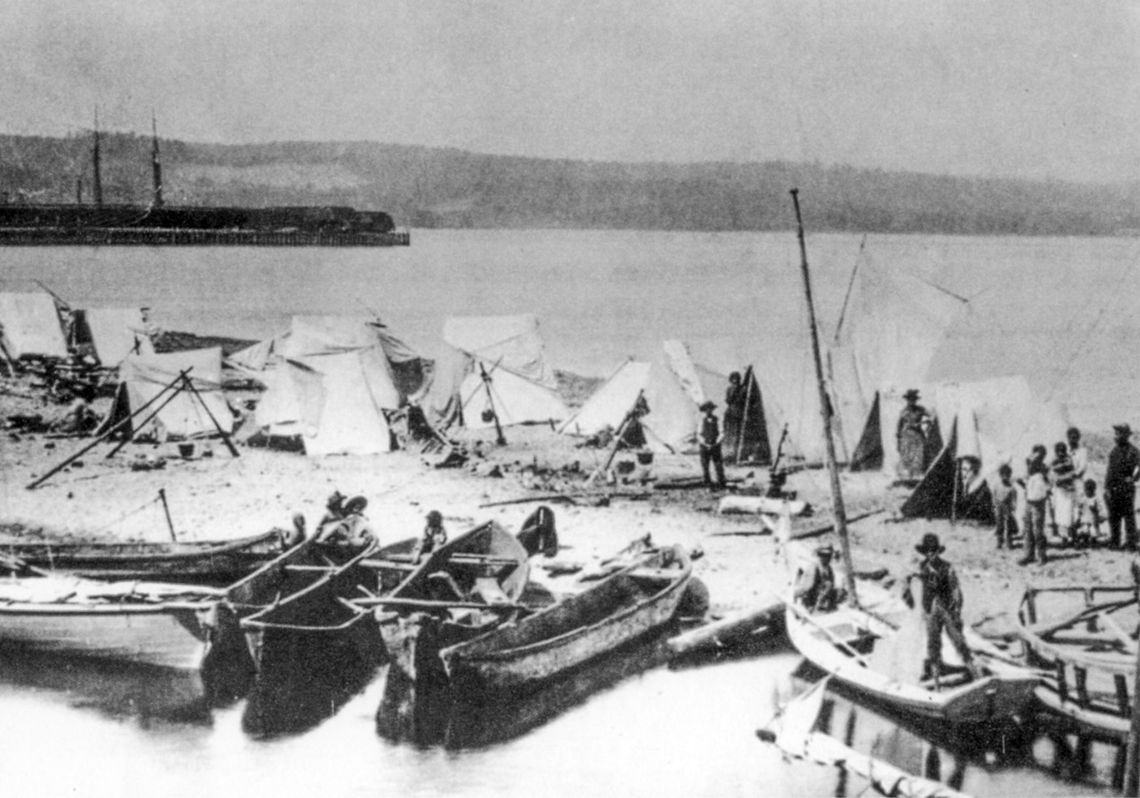
When white settlers came to the shores of Grand Traverse Bay, there were already Native Americans in small groups, traveling on foot and by canoe. When Europeans arrived, the Peshawbe/Peshaba family became acquainted with the Rev. Peter Dougherty and his mission community near the end of what came to be named Old Mission Peninsula.
The Indigenous people had seen schooners built by white settlers, and Chief Ben Peshawbe or son Gabriel built at least one schooner near the south end of the Old Mission Peninsula. The Peshawbe family had a vessel named “Wabezee” ( or other spellings: Wabeze, Wah-bu-see, Wabizee,Wilbizee, Miguzee) that was 60-foot long with deck and cabin. This little boat was known around Grand Traverse Bay as one which helped settlers get to their destinations. Around 1853 Chief Peshawbe had another boat named Eagle.
Gabriel’s mother was Agatha Kweshmeggaka. Pay-shaw-bay was another spelling for his family’s surname. Names for the native people were spelled a variety of ways, because whoever was doing the writing spelled it in the way it sounded to them. Spell-guessing also occurred with European settlers’ names, at times.
Some historical writing say in 1852, a group of Ottawa and Chippewa Indians from L’Abre Croche (Harbor Springs) founded a permanent settlement north of present-day Suttons Bay.
But residents in Leelanau placed a marker stating Peshabatown was settled by an Ottawa-Chippewa Tribe in 1845. Father Ignatius Mrak assumed leadership of the Catholic mission in 1855. They called the place Eagle Town. Another missionary, Father Angelius van Pacmel, soon followed and helped open the church and school in 1858. The people tapped maple trees for producing syrup. They planted gardens, trapped and fished. Baskets made from strips of black ash tree bark were sold to settlers and later tourists.
Reverend Philip Zorn served along Grand Traverse Bay in 1869 and 1870 and renamed the settlement Peshawbe or Peshawba.
The official M-22 highway sign marks Peshabestown.