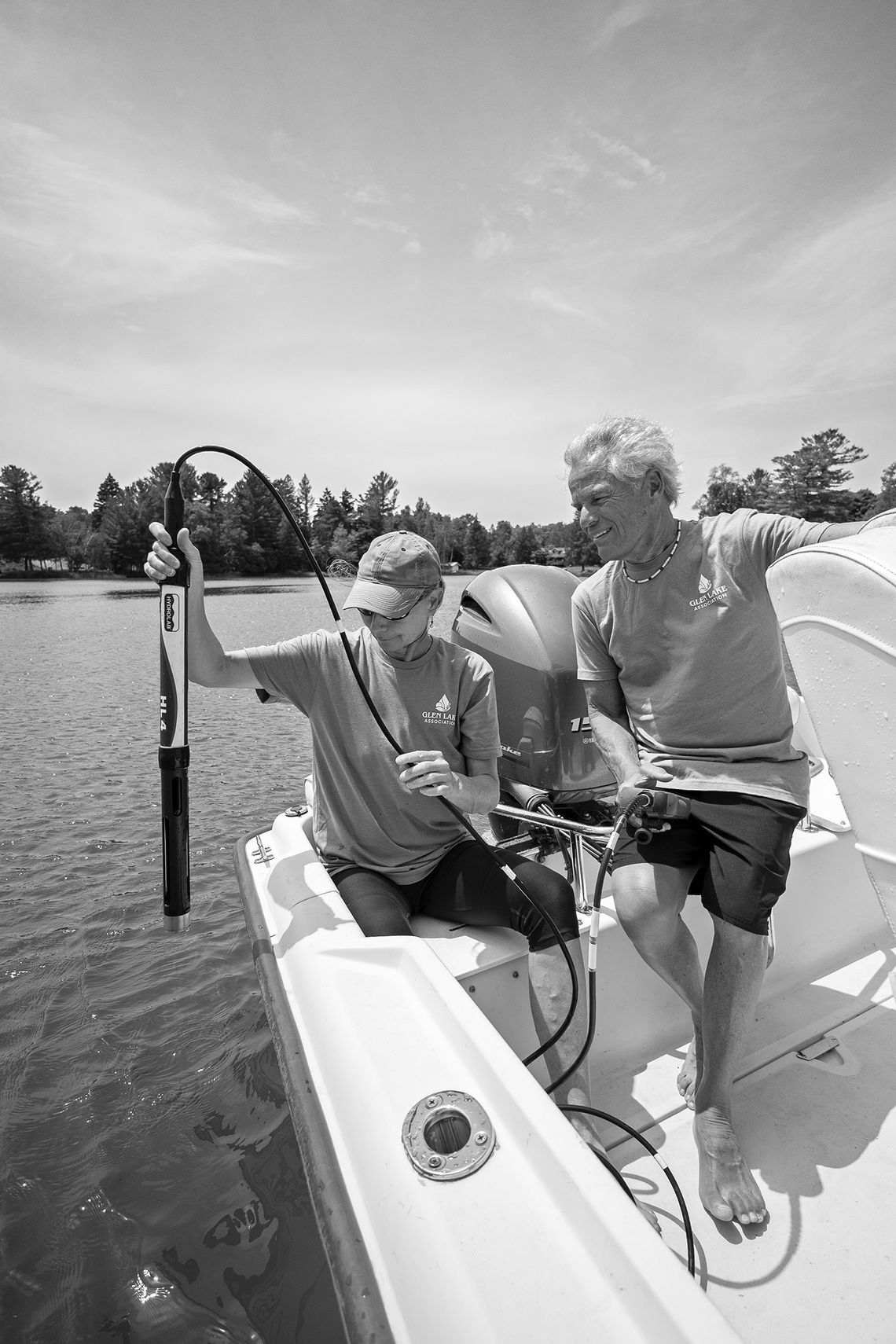
Rob Karner is retiring from the Glen Lake Association, closing out 12 years as the organization’s watershed biologist — a role he calls “an honor,” built on collaboration rather than solo effort.
“It’s been an honor to work on behalf of the watershed, together with the association and my network of collaborators,” Karner said. “It’s not just a oneperson effort, it’s a team effort. And I’ve been working with really high-caliber people. It’s just been a real joy.”
Karner was born in Dundee, Michigan, and grew up along the Crystal River halfway between there and Glen Arbor. A job offer brought him north in 1977, when he was hired straight out of student teaching to work at the Leelanau School — landing, in his words, his “dream job” on his very first interview.
“It was so wonderful,” he said. “I was just so impressed with the Leelanau School and the people there and the environment. It was unbelievable, beyond my wildest expectations.”
He went on to teach there for 38 straight years, retiring from the classroom about 12 years ago — and stepping into his second career as the Glen Lake Association’s watershed biologist, a position that was always part-time. It’s that role he’s now stepping away from.
Karner traces his love of northern Michigan’s ecology back to his early years at the University of Michigan Biological Station.
“I really gained an appreciation for the abundance and the diversity of life in northern Michigan,” he said. “It’s spectacular. When you go elsewhere and don’t see what we have here, it comes to light.”
That appreciation shaped how he taught. Rather than confine students to a classroom, Karner brought them into the field — canoes, waders, binoculars and small vans, exploring the lakeshore firsthand.
“What a great way to get to know what lives here yearround,” he said. “You don’t just look things up on the internet. You actually see and believe what’s there, and experience it, as opposed to just knowing about it.” He and his wife also founded the recycling center at the Leelanau School, which has operated ever since.
Karner believes he was the first lake biologist hired by a lake association in Michigan — a model more associations have since adopted. Over his 12 years with the Glen Lake Association, he points to several projects he’s especially proud of: Invasive species control: Working with bow fishermen from the Thundering Aspens community, Karner helped lead an effort to eradicate invasive Japanese koi from the watershed. The population has been kept in check through ongoing drone and camera surveillance, with only small numbers reported during breeding season.
“We hope it’ll never happen if we keep the pressure on to keep the population low,” he said.
Milfoil eradication: Glen Lake became the second lake association in the state, after Lake Leelanau, to eliminate Eurasian watermilfoil using non-chemical treatment.
Rethinking swimmer’s itch: Partnering with academic researchers from the University of Alberta, Karner studied the parasitic life cycle behind swimmer’s itch in depth — and discovered that three species of waterfowl, not just one, carry the parasite. The finding shifted strategy away from costly efforts to trap and relocate common mergansers, saving thousands of dollars, and toward educating swimmers on prevention instead.
“We really need to teach swimmers how to swim,” he said. “You don’t have to get swimmer’s itch if you don’t want to.”
Septic system research: Karner helped bring Glen Lake into a multi-lake university study — among the first of its kind — that definitively showed septic systems were influencing surface water quality. The 2018 findings were later used to help persuade county commissioners to adopt a countywide septic inspection ordinance triggered upon the sale of a property.
Working with the National Park Service, Karner helped establish a “no-mow zone” along roughly a mile of parkowned shoreline on the west end of Little Glen Lake. Native plants quickly returned once mowing stopped, which discouraged Canada geese from congregating on the beach — and, in turn, ended the E. coli outbreaks that had plagued the area.
“What a great story that was,” he said.
Mapping the lake bottom: While conducting underwater video surveys to search for Eurasian watermilfoil, Karner and his team also began cataloging every native plant and fish species they spotted along the way. The result is a GPSbased biological map, viewable on Google Earth, covering more than 100 sites down to the species level — documentation that had never existed before. “We have a beautiful biological map that we can trust and use for the future,” he said.
What’s Next
The Glen Lake Association is moving to hire a full-time biologist to succeed him — a step Karner welcomes — even though he never wanted the job to be full-time himself.
“For them to hire a full-time position is a testimony to the value of what they saw me doing part-time,” he said. “I’m grateful that a lot of what I’ve started would continue, and maybe more new things to come as well. I’m only wishing the best for the GLA.”
Retirement won’t mean stepping away from the watershed, though.
“You’re retiring from a job, but you’re not no longer a biologist,” Karner said. “I’ll still be watching the fish and the birds and the water quality — it just won’t be on any kind of employee basis. It’ll just be for fun.”
He plans to remain a fixture around Glen Lake in whatever form that takes.
“I’m going to continue to enjoy the watershed, continue to be a part of anything that happens,” he said. “So I’m going to keep going with watching, observing, marveling, wondering — all of those things come into play.”