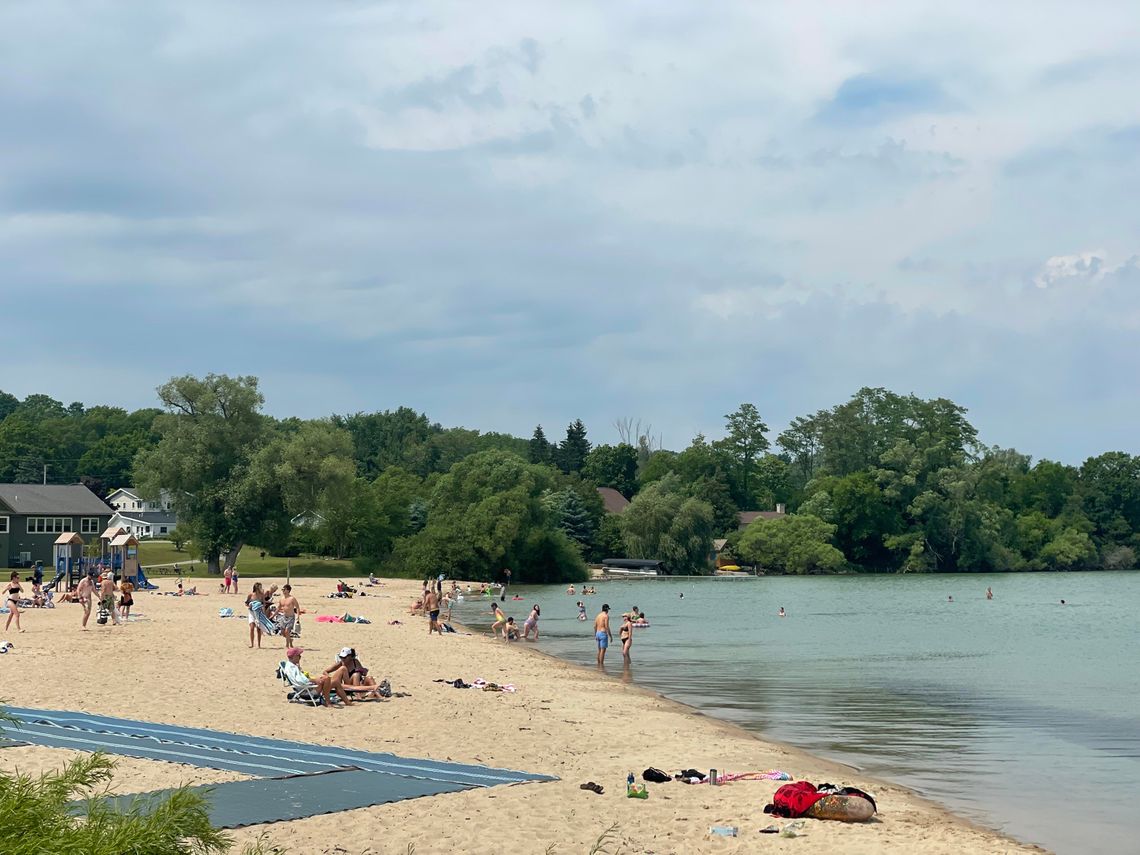
All eight monitored beaches in Leelanau County came back below the Benzie-Leelanau Health Department’s (BLHD) threshold for an E. coli advisory in the department’s latest water testing.
But, bacteria levels are just one part of a more complicated picture of water quality that includes other issues like harmful algae blooms and swimmer’s itch.
“Overall , Leelanau County beaches have great water quality year after year,” Dan Thorell, health officer for the BLHD said. “Yes, there are times when E. coli levels prompt either level 2 or level 3 advisories, but they are typically rescinded quickly after retests.”
The report released on July 30 showed that all eight monitored beaches, including Empire Beach, Greilickville Harbor Park, Van’s Beach in Leland, Northport Marina, Omena Beach, South Bar Lake, Suttons Bay Marina and Suttons Bay Park, came back with E. coli levels ranging from 3 to 70 E. coli per 100 milliliters of water, well below advisory thresholds.
Still, Northport had three partial advisories last year.
“Northport Marina Beach has been challenging over the years,” Thorell said. “There is a large storm drain that empties near the beach, so if there has been any rain day or night before sampling, E. coli levels are typically elevated.”
Good news is, the Watershed Center Grand Traverse Bay is working with the village on storm drain improvements that are expected to help.
He explained that stormwater runoff is actually the biggest factor behind elevated readings countywide.
“During and after rain events, animal waste and other contaminants are washed into storm drains and ultimately into nearby swimming areas,” Thorell said.
However, sunlight and ultraviolet radiation help break down E. coli when the onshore wind and waves stir up sediment and concentrate bacteria near shore.
That means an E. coli result is best understood as a snapshot of conditions at the time and place of the sampling, rather than a guarantee that conditions will remain the same throughout the week.
DNA based source tracking on elevated samples has found the bacteria rarely comes from people.
“It is typically from gulls or canine sources,” Thorell said. “This tells me that our beaches are not being influenced by human sewage, which is a testament to local management of water.”
Other potential water quality concerns, such as harmful algae blooms and swimmer’s itch require a different lens.
According to Annalise Povolo the director of administration and programs at the Lake Leelanau Lake Association (LLLA) and Stewardship Coordinator Elizabeth Haber, harmful algae blooms, or HABs, have not yet been documented on Lake Leelanau this year, though North Bar Lake, within the Sleeping Bar Dunes National Lakeshore has experienced some in recent years.
HABs can develop when water gets above 77 degrees and phosphorus levels are elevated, which is a condition the lake is trending towards. A 2025 analysis of three decades of water quality data, conducted by Grand Valley State University found that the lake is changing.
“The water temperature results showed that the water is getting warmer and staying warmer longer,” the LLLA reported, and phosphorus has crept upward over the past decade as well.
The concern isn’t simply that algae may become more visible. Certain cyanobacteria can produce toxins that may be harmful to people, pets and wildlife. Those toxins can cause health problems if contaminated water is swallowed or comes into contact with skin.
In response to the long term changes, the LLLA has expanded temperature and nutrient monitoring this year and acquired rapid test kits that can screen suspicious algae, though any positive results still requires the state to confirm it.
“There is no way to stop a bloom once it starts, and it can take days or months to dissipate,” Povolo and Haber said. “As such, prevention and monitoring are key.”
For swimmers, that means avoiding water that appears to have an unusual surface scum, discoloration or other signs of a possible bloom and keeping pets away as well.
“If you see something on the surface of the water that looks like spilled green paint forming a sheen on the water surface, you could be looking at a harmful algal bloom,” they said.
Anyone who suspects a HAB should avoid contact with the water and report it to the EGLE or the LLLA to be evaluated.
There is also an invasive species element to the lake’s changing ecosystem. Research on Lake Leelanau has found that zebra mussels, which have been present in the lake since the lake 90s, filter water which can remove some types of algae from the water and make conditions more favorable for toxin producing cyanobacteria.
“We are so fortunate to have relatively clean water in northern Michigan, but that is not a guarantee. We all have a part to play in ensuring our water stays clean and beautiful for all,” they said.
Then there’s swimmer’s itch, which is caused by microscopic parasites that cycle between aquatic snails and waterfowl. Unlike E. coli, swimmer’s itch isn’t something that would necessarily trigger a beach monitoring advisory, which makes it harder to track.
“Anecdotally, I can say that we have received reports of swimmer’s itch from our membership this year, though we do not have enough consistent reporting data to confirm whether cases are higher than previous years,” Glen Lake Association Executive Director Kate Gille said.
She explained that reports tend to rise simply because more people are swimming as the summer goes on and the snails and waterfowl involved in the parasite’s lifecycle vary year to year for reasons that aren’t always clear.
Right now, an online crowd-sourced map where swimmers can report cases of swimmer’s itch shows a concentration of reports around the Narrows between Big Glen Lake and Little Glen Lake. There are two reports on the far north end of Lake Leelanau and one reported point on the south west side of Little Traverse Lake.
Besides avoiding areas where it has been reported, swimmers can reduce their chances of developing swimmer’s itch by drying off immediately after getting out of the water, swimming in deeper water since the parasites tend to concentrate in shallower, warmer areas and waiting until later in the day to jump in the lake.
Together, the three seem to add up to a good summer to be in the water and an overall healthy lake system.
The swimmers itch map can be found at swimmersitch.info