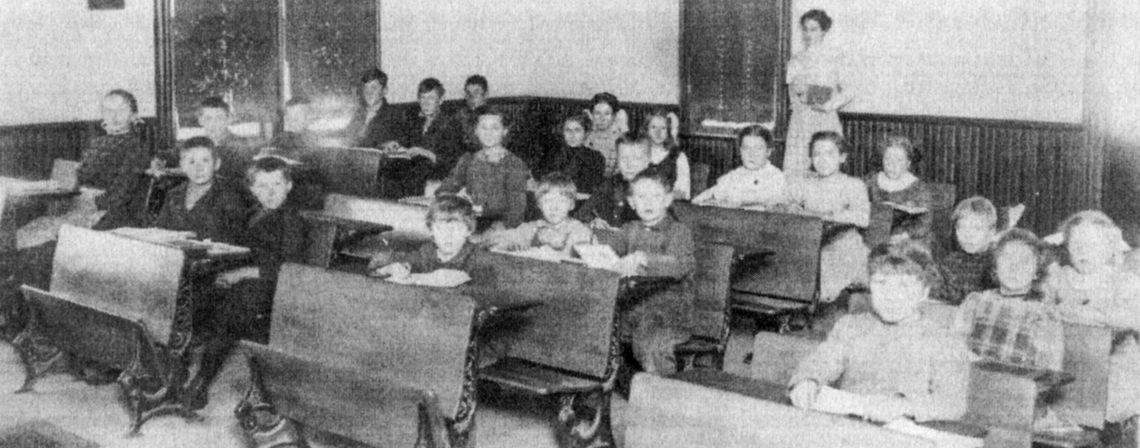
The following is an excerpt from “Good Harbor: the story and the people 1850 to 1931 by Norbert Bufka. Copies of the book are available at local bookstores.
On July 13,1787 the U.S. Congress under the Articles of Confederation pass the northwest of the Ohio River and made provisions for this territory to enter and the United States as free and equal states with the original 13. This forward-looking law said in Section 14, Article 3: “Religion, morality, and knowledge, being necessary to good government and the happiness of mankind, schools and the means of education shall forever be encouraged.”
The emphasis on education continued with the passage of a law by the government of the Michigan Territory April 12, 1827 which reinforced the idea that education was a public responsibility and that townships were integral to school development.
The law put township officials in charge of the school and required that any township that had 50 or more families must also have a schoolmaster.
An act in 1829 required townships “to elect five persons to serve for three years as commissioners of common school.”
Their duties included establish boundaries for the primary school districts. These early law clearly establish schools under local authority. This act also allowed districts to be in two townships, thus creating embryo districts that had no relation to the civil boundaries of townships and counties and help explain why school districts today are separate from township, county, and city boundaries.
In 1837 after Michigan became a state, one of the first laws concerned schools: “Each district elected a threemember board: they were moderator, assessor, and director. The moderator presided at all meeting, the assessor was responsible for tax collections, and the director had general management responsibilities. The township clerk was an exofficio member of the board.”
A law passed in 1843 established “a township board of inspectors” to replace the commissioners.
“The membership was fixed at three, including the township clerk” and declared that no district could be larger than nine sections, normally nine square miles It allowed consolidation of two or more districts under certain conditions. Even so, the number of districts grew to 7,164 in 1912. There were still over 6,000 in 1945.
The archives at the Cleveland Township hall indicate that the Board of School Inspectors had the responsibility to designate that area for each district as well as giving teacher exams and certifying teachers.
“Public Act 161 of 1859 authorized the establishment of a graded high school district for any district with more than 200 children between ages four and 18.” Public Act 119 in 1873 required a vote of the people for the first time before any consolidation of districts could take place or any division of the district.”
“Public Act 31 of 1909 abolished the township board of inspectors and transferred its responsibilities relating to the establish of district to the township board.”
In 1935 “Public Act 117 transferred its responsibility to the county board of education” for some counties and this procedure was extended to all counties in 1949, continuing until 1955 when the law was changed again.
“Public Act 226 of 1917 authorized the consolidation of three or more rural schools into a rural agricultural school district. A district formed under this statute was required to teach agriculture, manual training, and home economics.”
Leland School District was an agricultural district when it annexed the Good Harbor, the Star, and the Shetland schools. It took a course in agriculture in my ninth grade here (19551956). The old Good Harbor School was on site in Leland as the home economics classroom.
The Michigan Constitution of 1850 also promoted education in Section 4: “The legislature shall, within five years from the adoption of this constitution, provide for and established a system of primary schools, whereby a school shall be kept without charge for tuition, at least three months in each year, in every school district in the state; and all instruction in said school shall be conducted in English language.”