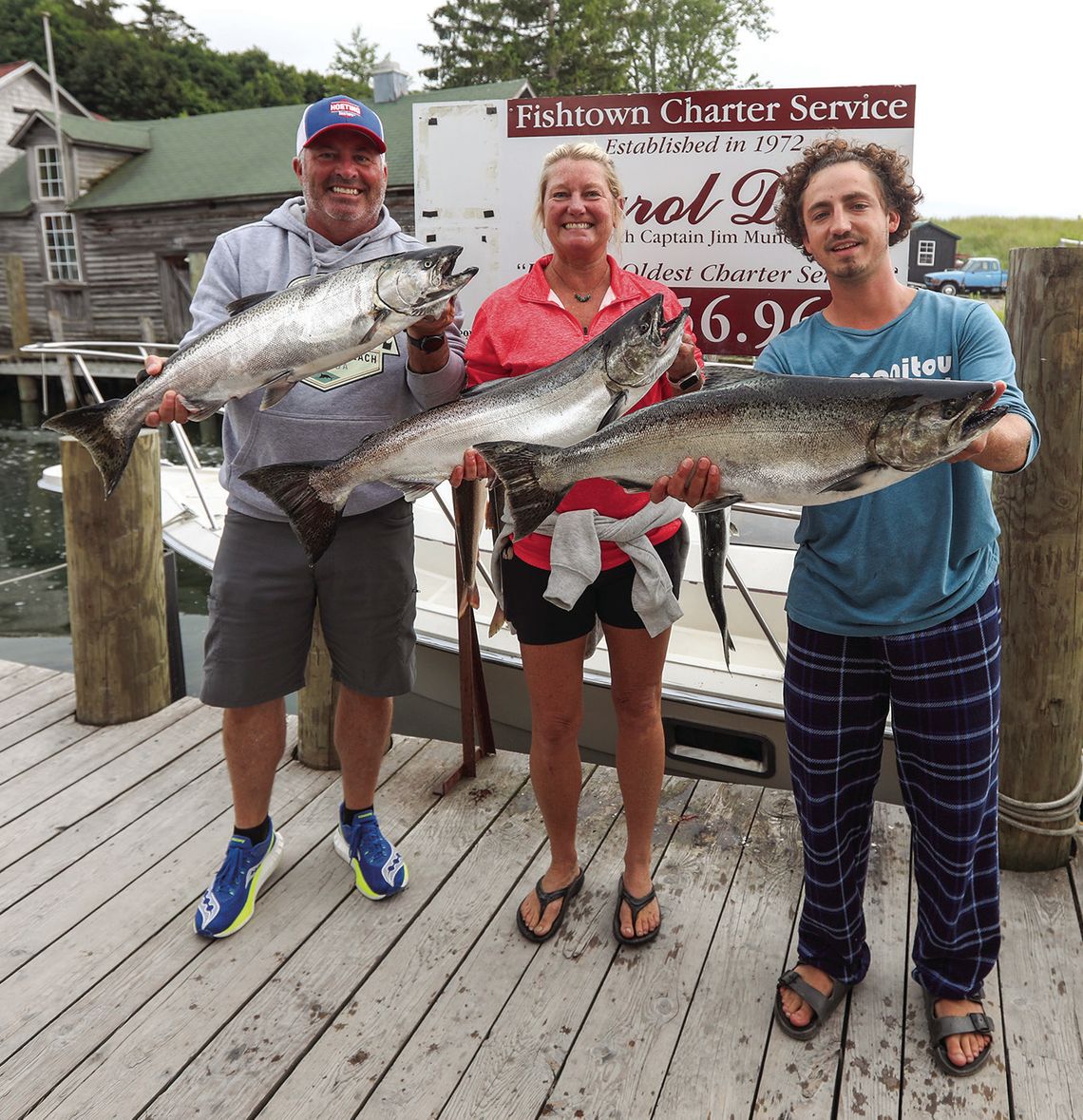
It’s not often that fishers agree that there are plenty of fish out there, so you might want to mark 2026 down in your diary.
There are plenty of fish. Salmon fishing has been redhot. You have to go back years to get anything close to the success that’s been commonplace off the shoreline of Leelanau County.
“It’s been the best fishing in 20 years,” offered Bob Schlitts, who has been a charter captain out of Leland even longer.
Captain Jack Duffy, who in the 1970s along with Jim Munoz were innovative pioneers in establishing a charter fishing fleet out of Fishtown, agrees.
“There were days when the bite was all day long. It’s the most fish I think I’ve ever marked,” Duffy said.
Leland, of course, is not alone in benefitting from an unpredicted spike in the salmon population.
Anglers have been smiling up and down the Lake Michigan shoreline.
What’s the reason? “I think a few things,” surmised Heather Hettinger, MDNR fisheries biologist stationed in Traverse City. “The lake has set up well for us this year to have good cold water so anglers haven’t had to make crazy runs to catch fish. The first and second bank both have had good water and fish on them for a longer duration, so that’s been nice. Fish numbers are really high right now. For adult salmon we have a very strong year class out there (created by) really good natural reproduction and recruitment of hatchery fish.”
Another seasoned salmon angler, Rodney Price, also keyed in on the colder water. Also fishing out of Leland, he’s been finding salmon in 70-80 feet of water. During past summers, salmon have sunk down to 150 feet of so to find their ideal living temperatures of 45 to 52 degrees.
Price, who spent several years as a first mate for Duffy and has fished out of Leland since high school, has found the salmon fishing to be surprisingly easy.
“It’s been the best fishing in a long time,” he said, stating that on a recent outing to the Manitou islands he and passengers encountered 40 salmon hits on lures and boated 20.
While numbers have been outstanding, size of four-yearold fish has been down a bit to a 12- to-20-pound range. Hettinger explained.
“Size of adult chinook this year is underwhelming. I am personally seeing three-yearold salmon hit the back deck of my boat that are the same size as four-year-olds, when that four-year-old should be 8-10 pounds heavier. At some point this group of adult fish struggled with food.
Whether that’s because this year class was so large in numbers or these fish didn’t come across alewife regularly ... their life history was poor, These fish aren’t sickly, their overall condition looks good, but they are certainly much smaller than what they morphologically should be,” Hettinger said.
Their smaller size will probably result in fewer salmon being planted next year.
“We are most likely looking at a stocking cut in 2027. We work with the Lake Michigan Technical Committee and the Lake Michigan Citizens Advisory Committee to review a handful of factors or ‘red flags’ that our salmon catch data and baitfish assessment data contribute to. Factors include things like the average size of female chinook returning to our weirs around the lake, and angler catch rates. For the past couple of years we have been below the target number for the average size of females, and above the safe threshold for angler catch rates.
“While we are still discussing the specifics on the stocking reduction with our advisory groups, its coming,” Hettinger said.
In the meantime, anglers have been having fun.
“I know these catch rates are great, and everyone likes catching a lot of fish. But they also are not sustainable year after year. Adult chinook salmon are not designed to be this small,” Hettinger warned.