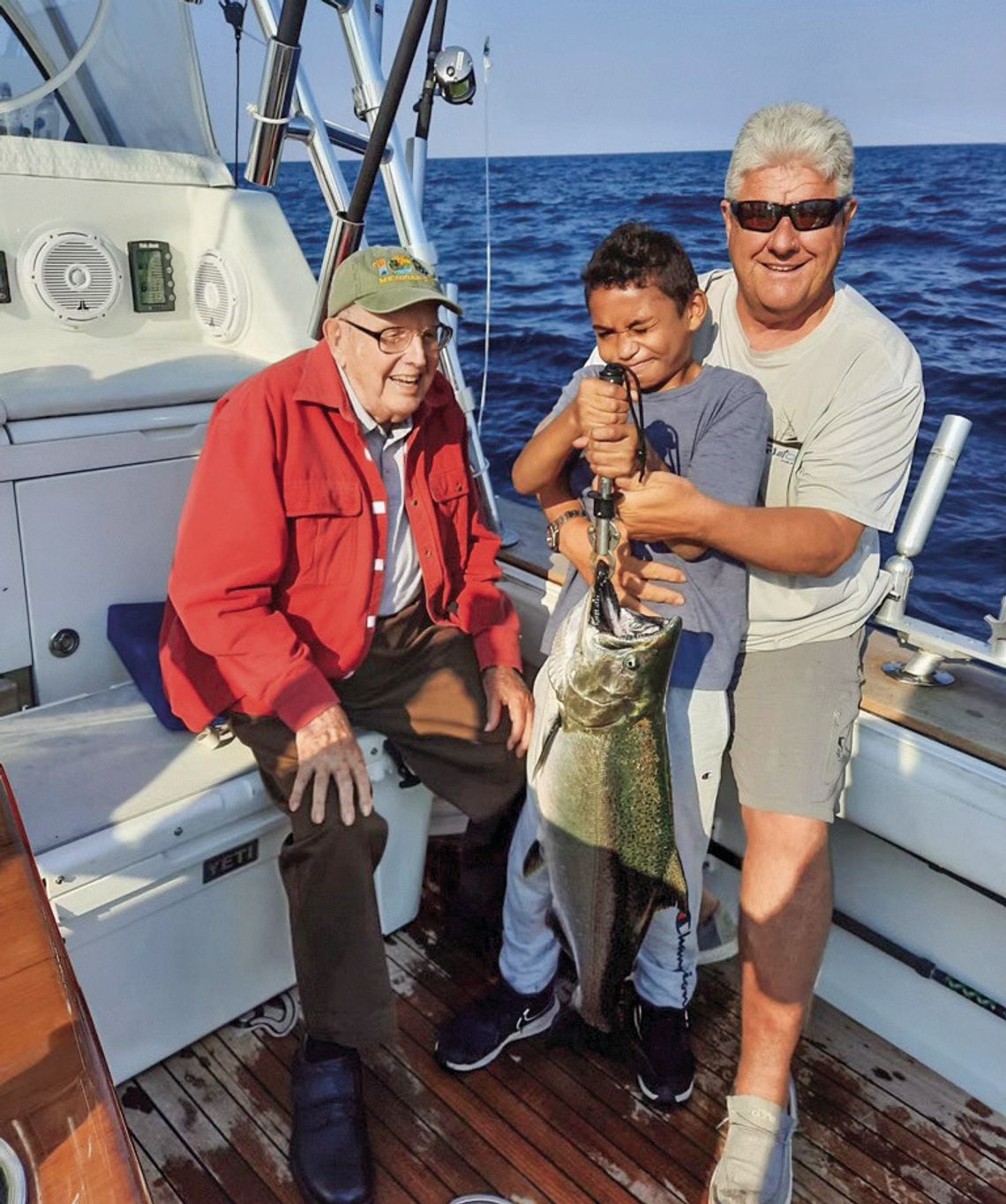
Fisheries expert and gambler Dr. Howard Tanner, whose legacy is being celebrated across the state following his death on Aug. 16 at the age of 102, caught his last salmon about five years ago off the shoreline of Leelanau County.
It was netted about 20 clicks from the very first successful salmon planting in the Great Lakes, at the mouth of the Platte River in Benzie County.
“He was very gentle, very soft spoken, very polite,” said boat owner Mike Marsh. “When he talked about the (salmon) program, you could see his passion coming through.”
Tanner led the vision that created the Great Lakes salmon fishery.
He led a long and storied life. He grew up near Mancelona where he made spending money by showing downstate sports where to catch enough brook trout to keep them out of his favorite creeks. After marrying his sweetheart, Helen, he was whisked to the South Pacific by the Army to fight in World War II.
One of his interesting stories — and he had a creel full of them — was paddling with a buddy up a river in the Philippines to fish. During the long trip, an urgent message came through requiring him to immediately get on a plane headed to Manila. That plane took off without him and crashed, killing everyone aboard.
After the war he returned to Michigan State College, now MSU, where his studies caught the eye of academics and state fisheries biologists. After much internal debate — the Tanners loved northern Michigan, where they camped in a tin trailer while conducting research on North Twin Lake for the state Conservation Department— the growing family moved west when he accepted a position as assistant professor at the University of Colorado.
While there he learned the ecological dangers of introducing nonnative species such as brook trout to western rivers. He also learned that taking chances can provide rewards. Planting salmon in the Great Lakes fell within the latter realm.
As chronicled in his book, “Something Spectacular: My Great Lakes Salmon Story,” Tanner related, “The free-wheeling western style of doing things had forever altered my approach to challenges and opportunities. Thus, when the opportunity to plant salmon in the Great Lakes came, I was ready to seize upon it and commit to the boldest decision I ever made,” The Tanners’ return to Michigan in 1964 provided financial stability and fit their family needs. He had been offered the head fisheries division job in his home state, which paid $15,000 compared to $10,800 for the same position in Colorado. And he and Helen were single children with needs to live closer to their aging parents.
It was a challenging time for the Great Lakes. Actually, more of a devastating time.
Lake trout had been the mostsought sport fish, but their population was devastated in the 50s by an accidental introduction of lamprey from the Atlantic Ocean. Some time in the early 60s ocean-born alewives followed lamprey down the Erie Canal and found no credible predators in the Great Lakes.
They reproduced and grew at astounding rates, overtaking their capacity to survive, and piled up on beaches up and down Lake Michigan. Shoreline owners in Leelanau County raked them into piles and set bonfires, hoping to contain the stench.
Tanner was only head of Michigan fisheries for 22 months before becoming head of the College of Agriculture and Natural resources at MSU, but that was long enough for him to throw the dice at salmon. He was gambling with his career However, recorded sessions of Tanner at public meetings and a reading of his written thoughts show that he harbored little doubt that salmon were the key to turning around the Great Lakes fishery. He encountered doubters, of course, including fisheries professionals in nearby states and even the Great Lakes Fisheries Commission. He respected their opinions because his training also stressed the dangers of transplanting foreign species.
“Then comes the moment,” he said at a conference. “I went home one night, probably midevening, and I got a phone call.” He learned that coho salmon eggs would become available from the West Coast. It was the fall of 1964, and he had been head of Fisheries for two months.
Jim Munoz, a tenured charter captain in Fishtown, recalled the early results of coho salmon plants in the Platte River. Alewives are the natural prey fish for salmon.
Munoz and his father motored north from East Lansing to Platte Bay in 1967 with an 18-foot boat powered by a 12-horse Johnson motor. They were better prepared than most.
“It was just a mad house. People were out there literally in anything that would float (and) people couldn’t believe what they were seeing. My dad and I had never caught a salmon. We started catching jacks, and they were 10-15 inches, and we thought that was an unbelievable thing. We were tickled to death. All of a sudden we saw a mature salmon floating on the surface. It was ten pounds, and my God, we had never seen anything like that,” he said.
After Tanner’s departure, the coho salmon program was expanded and chinook salmon, which can top 20 and even 30 pounds, were introduced.
Paul Stowe of Centerville Township is manager of the Platte River State Fish Hatchery, which rears more salmon than any other hatchery in the Great Lakes. He considers himself fortunate to have met Tanner.
“What a great guy. He didn’t have a clue whether it would work, and I don’t think anybody did. He probably didn’t think it would be his life’s legacy. But it’s gotten so many people into the outdoors and changed so many lives … ,” Stowe recalled, also in an earlier interview.
Marsh had the privilege of fishing with Tanner twice, the other time out of Holland. He made a connection with the Project FISH (Friends Involved in Sportfishing Heritage) program run by MSU through director Mark Stephans, one of Tanner’s dearest friends.
Marsh salmon fishes out of a 58-foot Sportfish pontoon. Its stability is easy on aging bodies. He enjoys taking young and older fishers out for salmon.
On Tanner’s last salmon trip, he handled the rod on an 18-pound Chinook that was hellbent on making it to spawning season.
Tanner prevailed. “It was not an easy fight,” Marsh recalled.
Marsh, a Leland Township resident, thinks of Howard Tanner often while boating salmon from southern Lake Michigan to Lake Superior. He and other anglers have been especially appreciative of Tanner’s bold gamble this season, which is one of he best in memory off the shoreline of Leelanau County.
“I don’t think anyone could have predicted what a mark he would leave around the Great Lakes,” Marsh said.