Learning to see the landscape:
In late summer, autumn olive becomes difficult to miss.
Its branches fill with small red berries flecked with silver, while the pale undersides of its leaves shimmer in the wind. Along roadsides, old fields, woodland edges, and open hillsides, the shrub has become a familiar part of the landscape.
Familiar, however, does not always mean native — or harmless.
Autumn olive was introduced to the United States and later planted for erosion control, windbreaks, and wildlife habitat. It grows quickly, tolerates poor soils, and produces abundant fruit that birds spread across the landscape.
The qualities that once made autumn olive useful are also what allow it to spread. It thrives in difficult conditions and can form dense thickets that leave fewer opportunities for young trees, wildflowers, and native shrubs to take hold.
What appears to be a single shrub is part of a larger story.
Leelanau County’s forests, fields, wetlands, and dunes are living communities. Native plants support insects. Insects feed birds. Shrubs provide food and nesting cover. Trees hold soil, filter water, and help shape the places we recognize as home. When one plant begins to dominate, those relationships narrow.
This is why knowing what we are looking at matters.
Our yards, woodlots, roadsides, and fields are not separate from Leelanau’s natural areas. Birds cross property lines. Seeds travel with them. What grows on one property can influence the landscape.
That connection can feel daunting, especially where autumn olive has spread across an old field or woodland edge. Our District Forester regularly hears from landowners who are unsure where to begin.
Stewardship does not require solving the entire problem at once. It can begin with one shrub.
Small plants can often be pulled when the soil is moist, taking care to remove the root crown. Larger shrubs usually require cutting and follow-up because autumn olive readily resprouts. Correct identification should come first, and larger projects may benefit from guidance from the Leelanau Conservation District’s forester or another qualified natural resource professional.
Follow-up matters. Young plants may emerge from seed already in the soil, and cut shrubs can resprout. Returning to the site over several seasons is often more important than trying to finish everything in a single day.
Removing autumn olive also creates an opportunity to restore what grows in its place. Serviceberry, American hazelnut, red-osier dogwood, winterberry, Continued from Page 3
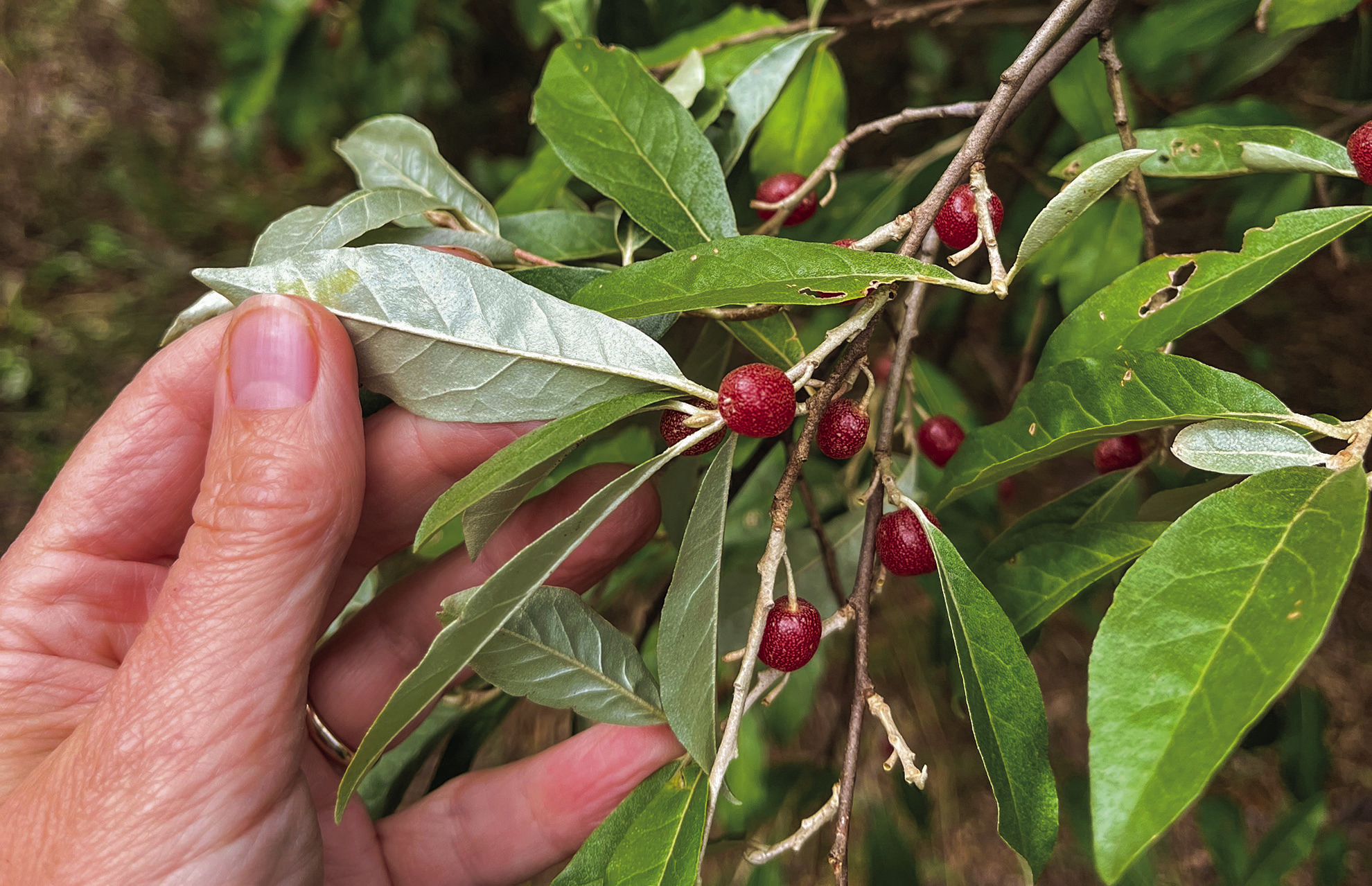
Autumn olive
and other native shrubs can provide food and shelter for wildlife.
The goal is not simply to remove something unwanted. It is to make room for a more diverse and resilient landscape.
Stewardship grows from attention, affection, and a willingness to care for a place. Sometimes conservation begins with a large restoration project. More often, it begins by learning the name of something we have passed a hundred times—and deciding to care for what grows in its place.
The Leelanau Conservation District provides guidance on invasive plant identification, forest and habitat management, native plant selection, and land stewardship. County residents may contact the District at (231) 256-9783 or [email protected].